
Early Childhood · Communication Skills · Kavi Nagar, Ghaziabad
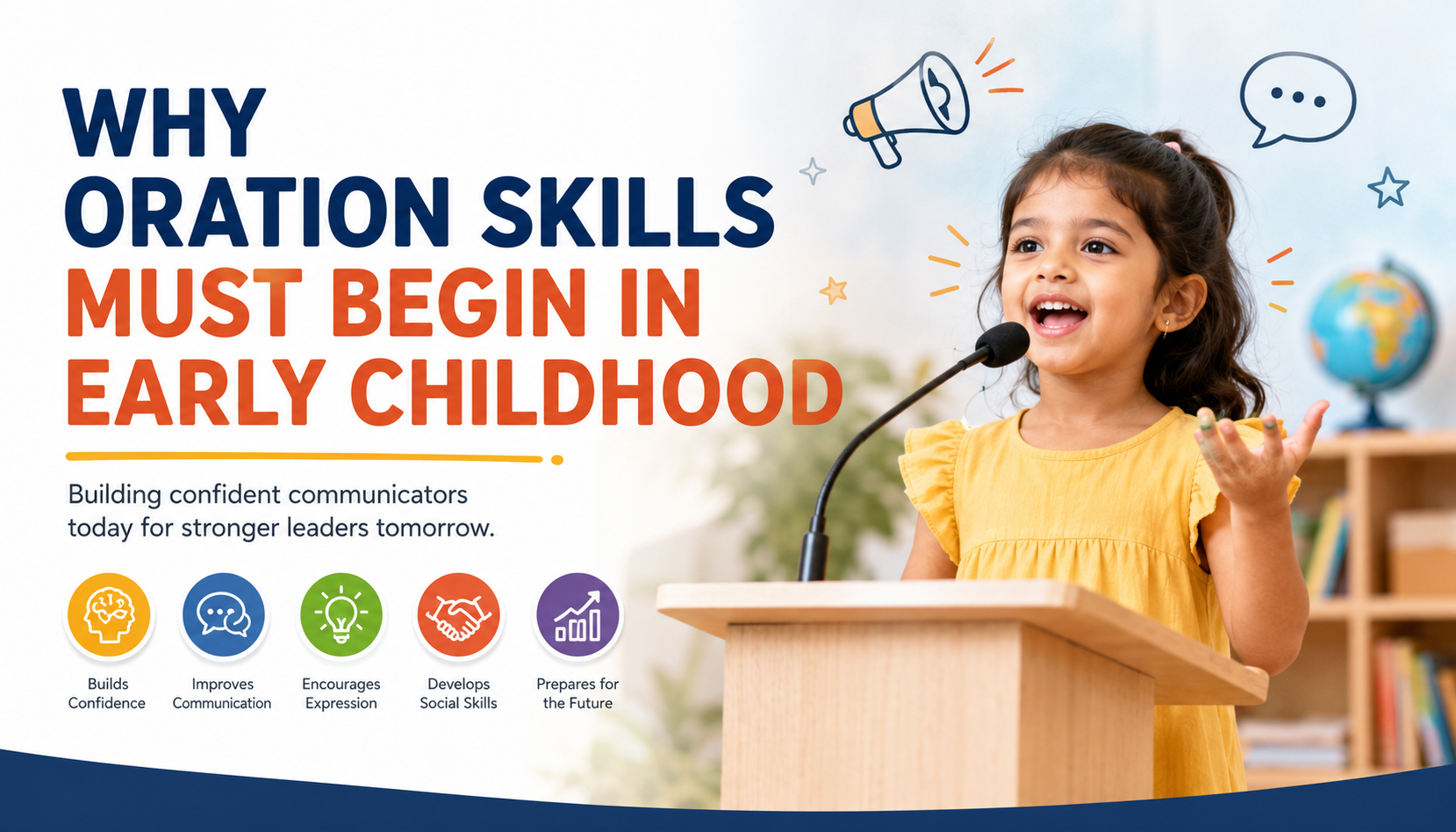
Building Confident Voices: Why Oration Skills Must Begin in Early Childhood
A child who cannot express what they know struggles just as much as a child who does not know enough. Here is why communication skills need to start at 2.5 years, not at school age, and how parents and preschools can build that foundation together.
There is a particular kind of helplessness that parents sometimes describe. Their child clearly understands everything. Sharp, observant, curious. But put them in front of a teacher who asks a question, or a relative who wants to hear about their day, and the words simply do not come. The child knows. They just cannot seem to say it.
This gap between what a child holds in their head and what they can comfortably express is one of the most underestimated challenges in early childhood development. And it is far more common than parents realise, because the solution is rarely something dramatic. It is something that happens, or does not happen, in the quiet ordinary moments of a child’s daily life.
Building a child’s ability to speak confidently takes time, consistency, and the right kind of environment from a very early age. Not a speech class, not a special programme. Just the right kind of daily interaction, at home and at preschool, starting well before most people think to begin.
The Gap Between Knowing and Saying
Most parents realise their child has a communication gap at a moment of embarrassment. The school event where their child freezes at the microphone. The classroom where their child never raises a hand even when they clearly know the answer. The family gathering where relatives ask questions and the child stares at the floor.
That moment feels sudden, but it was building quietly for years. The child who never had to explain their thoughts in words because a parent always guessed. The child whose questions were answered before they finished asking them. The child who spent more time watching a screen than talking to a person. Each of these patterns, individually small, adds up over time.
The good news is that this gap is entirely closeable. But it is much easier to prevent than to fix. A child who grows up being genuinely listened to and gently encouraged to put things into words from age two or three develops a relationship with spoken language that becomes instinctive by the time they are six. A child who starts that process at eight has years of hesitation to work through first.
Why Communication Skills Matter More Than Before
School has changed significantly in the last two decades. The classroom that most parents grew up in was largely about sitting, listening, and writing. Speaking was for special occasions like debate or drama. Today’s classrooms ask something different. Children are expected to participate, present, discuss, and defend their thinking on a regular basis, sometimes from as early as Class 1.
Show and tell, group projects, oral assessments, class discussions, presentations to the school. These are now a routine part of education, not an exceptional one. A child who cannot manage them does not just feel uncomfortable. Their actual academic performance suffers, because teachers who never hear a child speak cannot fully assess what that child understands.
Beyond school, the world that children are growing into rewards expression heavily. Job interviews, client presentations, team meetings, negotiations. The ability to communicate with clarity and confidence is no longer a soft skill that nice to have. It is a practical requirement. Starting that development at preschool age is not premature. It is simply timely.
A child who is intelligent but cannot express that intelligence is at a real disadvantage. Not because they lack ability, but because others cannot see what they have. Communication skills are not separate from academic success. They are one of its most visible engines.
Ages 2.5 to 6: The Window That Matters Most
Between 2.5 and 6 years, something remarkable is happening in a child’s brain. Language is being acquired at a pace that will never be replicated again. Vocabulary expands, sentence structures form, and the emotional associations with speaking, whether it feels safe or frightening, comfortable or awkward, are being laid down with every single interaction.
Children this age are also naturally wired for expression. They want to tell you things. They want to narrate their own experiences, ask endless questions, and perform to whoever is watching. That natural drive is an enormous asset, but only if the environment meets it well. A child who tries to tell a story and gets cut off, corrected, or ignored learns that expressing themselves is not worth the effort. A child who is listened to patiently and responded to warmly learns the opposite.
Preschool plays a uniquely important role here. It is often the first place where children speak in front of a group of peers, with an adult who is not their parent. That experience, if handled with care, plants a seed of confidence that grows steadily. If handled poorly, it can set up an aversion to speaking in public that takes years to overcome.
This is why the choice of the best playschool in Kavi Nagar Ghaziabad is not just about academics or facilities. It is about what kind of speaker your child will become by the time they leave.
What Parents Can Do at Home
The most powerful influence on a child’s communication development is not school. It is home. Specifically, it is the quality of conversation a child experiences on an ordinary Tuesday afternoon with the people they love most.
The single most important thing a parent can do is ask questions that require more than a yes or no answer, and then actually wait for the response. Not fill the silence. Not prompt with the answer. Just wait, with patient attention, while the child works out what they want to say. That pause is where confidence is built.
When a child makes a grammatical error, the instinct to immediately correct it is understandable but counterproductive at this age. A child who is corrected every time they speak learns to speak less, because the process starts to feel like a test they are failing. A far more effective approach is to simply respond naturally using the correct form. If a child says “I goed to the park,” you say “Oh you went to the park, what did you do there?” The correction happens without the child ever feeling corrected, and the conversation continues.
Beyond conversation, reading aloud together every day, even for ten minutes, exposes children to vocabulary and sentence structures they would not encounter in ordinary speech. Children who are read to regularly almost always develop richer spoken language, because they have more words available to them when they need them.
Practical Activities for Every Day
None of these require special materials or dedicated time. They fit naturally into what most families already do.
-
Daily conversation with open-ended questions Instead of “Did you have a good day?” try “What was the most interesting thing that happened today?” Give the child time to think. Do not fill the silence. The thinking itself is part of the practice.
-
Storytelling from books and imagination After reading a story together, ask your child what they think happens next, or to retell it in their own words. There is no right answer, which means there is no wrong answer either. This freedom is what makes children willing to try.
-
Role play in everyday scenarios Shopkeeper and customer. Doctor and patient. Teacher and student. Children who role play regularly become remarkably comfortable switching registers, adjusting how they speak depending on who they are speaking to, which is a sophisticated communication skill.
-
Show and tell at home Ask your child to pick one object each week and tell you three things about it. Why they chose it, what it does, and something they like about it. Over weeks, this builds the habit of preparing a thought and delivering it with a beginning, middle, and end.
-
Think-and-speak prompts Ask questions that require genuine thinking: “If you could change one thing about our house, what would it be and why?” The why is everything. Children who regularly justify their opinions develop the kind of structured thinking that underpins confident public speaking for years to come.
What to Expect at Each Stage (Ages 2.5 to 6)
Communication development is not a single leap. It builds in layers across different stages, and knowing what is typical at each age helps parents and teachers offer the right kind of support without pushing too hard or expecting too little.
Building Comfort in Speaking
At this stage, the goal is simply comfort. Can the child talk about their name, their family, and their favourite things without shutting down? Simple self-expression is the whole objective. Do not push for sentences or structure yet. Just encourage the talking.
Describing and Narrating
Children this age can begin to describe their daily routine, talk about what they had for lunch, or narrate a simple experience from earlier that day. Sentence formation gets cleaner. Encourage them to use connecting words like “and then,” “because,” and “but.”
Structured Communication
Now children can describe pictures, tell short stories with a beginning and end, and talk about festivals, places, and experiences with growing vocabulary. This is a good time to introduce show and tell and to start asking “why” questions regularly.
Expression and Basic Presentation
A child at this stage should be able to share an opinion, explain a simple concept, and participate in a short group discussion or presentation. This is the foundation of everything that comes next in formal schooling. Children who reach this milestone comfortably tend to find Class 1 far less daunting than those who do not.
How The Little Scholar Playschool Ghaziabad Builds Oration
At The Little Scholar Playschool in Kavi Nagar, Ghaziabad, communication development is not a separate subject or a once-a-week activity. It is woven into how every single day runs.
Circle time each morning gives every child a turn to speak, share something from their life, or respond to a question from the teacher. It is low pressure, warm, and consistent. Children who were initially reluctant to speak in front of the group typically find their voice within a few weeks simply because the environment makes it safe to try.
Show and tell sessions run regularly, and the school’s approach to them is deliberately child-led. Children choose what they bring and what they say about it. The teacher’s role is to listen, ask a question, and let the child feel the experience of being an audience’s full attention. That feeling, once experienced, tends to be something children actively want again.
Storytelling and role play are built into the weekly rhythm. Not as performance or assessment, but as play. A child pretending to be a shopkeeper is practicing vocabulary, sentence construction, turn-taking, and adjusting their communication based on who is in front of them, all at the same time, without knowing they are doing any of it.
The school’s philosophy on correction is also worth noting. Teachers here focus on positive reinforcement rather than fixing mistakes in the moment. A child who is applauded for trying will try again. A child who is corrected publicly will think twice. Over time, the culture of encouraging expression rather than demanding accuracy produces children who are genuinely comfortable speaking, which is the whole point.
You can read what families across Ghaziabad say about The Little Scholar on their Google Business profile.
What Confident Communication Does for a Child Long Term
The benefits of early oration development are not confined to school. They show up across every dimension of a child’s life as they grow.
Academically, children who communicate well tend to participate more in class, which means they get more feedback, ask more questions, and understand content more deeply. Teachers also simply have a better picture of what they know, which affects assessment in both formal and informal ways.
Socially, children who can express themselves clearly find it easier to make friends, resolve conflicts without physical escalation, and navigate the complex social dynamics of a school environment. The child who can say “I did not like that, it hurt my feelings” is in a fundamentally different position from the child who can only respond with withdrawal or aggression.
Later in life, the person who can walk into a room and communicate their ideas with clarity and warmth has an advantage that no amount of technical knowledge alone can replicate. That person started practicing at three years old, at a kitchen table or in a preschool circle, with someone who listened carefully and made them feel that what they had to say was worth hearing.
Give Your Child a Voice That Will Take Them Far
If you are looking for the best playschool in Kavi Nagar Ghaziabad that builds genuine communication confidence alongside early academics, The Little Scholar team is happy to tell you more. The admission inquiry form takes just a couple of minutes.
Frequently Asked Questions
At what age should oration and public speaking skills begin?
As early as 2.5 years, through simple everyday conversations, rhymes, and storytelling. Children at this age are naturally expressive and not yet self-conscious about making mistakes. That window is the easiest and most natural time to build the habit of confident speaking. Waiting until primary school means working against several years of already-formed hesitation.
How can parents improve their child’s communication skills at home?
The most effective approach is consistent daily conversation using open-ended questions. Ask questions that require your child to think and explain, then wait for the answer without filling the silence. Avoid correcting grammar in the moment. Instead, model the correct form naturally in your response and keep the conversation going. Storytelling, role play, and weekly show and tell at home are all genuinely effective supplements.
My child is shy and hesitates to speak. What should I do?
Start with the smallest possible audience. One grandparent. A puppet. The family pet. As your child gets more comfortable expressing themselves in those safe settings, gradually introduce slightly larger ones. The mistake most parents make is creating performance pressure before the child has built confidence. Shy children often become the most thoughtful communicators once they feel genuinely safe to try.
Is show and tell really effective for young children?
Yes, and it works specifically because the child controls the topic. When a child talks about something they chose and care about, the fear of not knowing what to say disappears. Over time, the format builds the habit of preparing a thought and delivering it to an audience, which is the core structure of all public speaking, from a classroom presentation to a boardroom pitch.
Does too much screen time affect a child’s communication skills?
Yes. Watching a screen is passive. A child receives language but does not practice it. Real conversation requires listening, processing, forming a response, and adjusting based on what comes back. These are skills that only develop through actual back-and-forth interaction with real people. When screen time consistently replaces conversation time, particularly in the early years, the gap becomes noticeable by the time children start school.
What is the best playschool in Kavi Nagar Ghaziabad for communication and oration?
The Little Scholar Playschool in Kavi Nagar, Ghaziabad builds communication development into its everyday curriculum through circle time, storytelling, role play, show and tell, and consistent positive reinforcement. It is widely regarded as one of the best playschools in Ghaziabad for holistic early childhood development. You can read parent reviews on their Google profile.
A Voice Is Built, Not Born
Oration is not a talent that some children have and others do not. It is a skill that grows, or does not grow, based on the environment a child moves through in their early years. The child who speaks with confidence at ten learned how to do so at three, in small moments, with people who made it feel safe to try.
For parents in Ghaziabad, the most powerful thing you can do for your child’s communication future is not enrol them in a special class. It is simply to listen to them, consistently and patiently, every single day. And to choose the right preschool, one that does the same thing, when you are not there to do it yourself.