
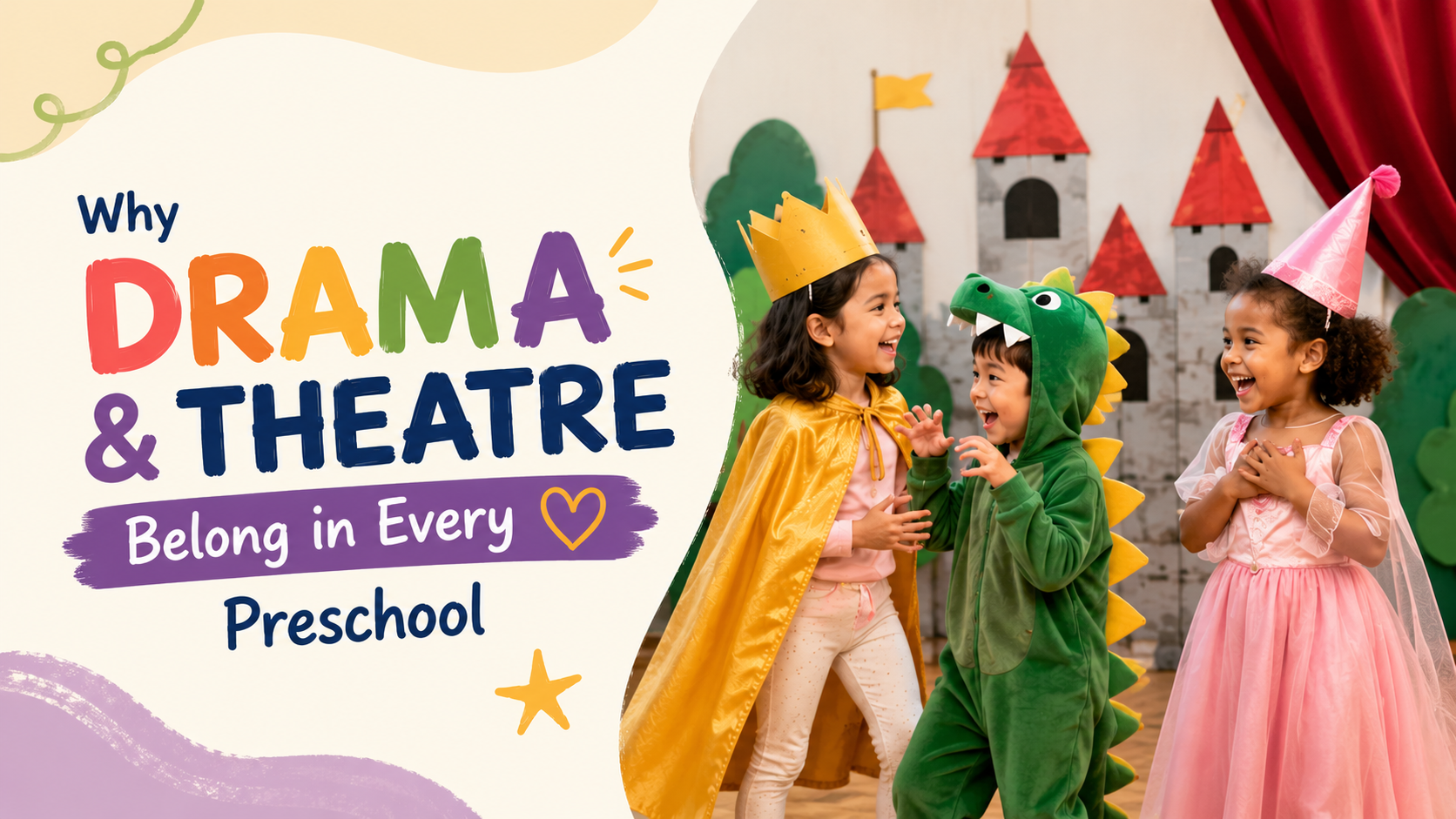
Early Childhood Education · Drama & Theatre · Best Play School in Ghaziabad
Why Drama and Theatre Belong in Every Preschool Classroom
When a four-year-old picks up a puppet and gives it a voice, or walks into a pretend market and haggles over invisible tomatoes, they are not just playing. They are doing some of the most complex developmental work of their early years. Here is why drama deserves a permanent place in every preschool, and how the best play schools in Ghaziabad are already making it happen.
Most parents have watched their child transform into a completely different person the moment they pick up a toy phone, wrap themselves in a dupatta and announce they are now the doctor, or line up stuffed animals for an imaginary school assembly. It is funny, and sweet, and easy to let pass without thinking much of it. But what is happening in those moments is genuinely significant.
Drama in early childhood is not about training children to perform. It has very little to do with spotlights or scripts. What it is really about is giving children the tools to understand their world, practice being in it, and express themselves with increasing confidence and creativity. Parents searching for the best play school in Ghaziabad are increasingly asking about this, and rightly so, because the schools that take drama seriously tend to produce children who are noticeably more expressive, more socially capable, and more emotionally aware than those that treat it as an occasional treat.
Drama Is Not About Performance
The word “drama” carries baggage. For most adults it brings up images of school plays with children frozen in terror at the edge of a stage, or perhaps a few confident kids carrying the whole production while the rest shuffle their feet. That version of drama is real, but it is not what we are talking about here.
Drama in a preschool context is almost entirely process-based, not performance-based. It happens in circle time when a teacher asks children to act out what the bear did in the story they just heard. It happens in the corner where two children have set up a pretend restaurant and are debating who gets to be the chef. It happens when a child holds a puppet and discovers, to their own surprise, that the puppet has opinions and a voice and something to say.
None of this requires an audience. None of it requires perfection. What it requires is space, materials, and adults who understand what is happening and allow it to continue rather than redirecting children to something more structured. The best play schools in Ghaziabad do exactly that, and the difference in their children shows.
What Drama Actually Builds in Young Children
Ask a child development researcher what drama does for young children and the list runs long. But for parents, four things matter most.
Communication Skills
Drama pushes children to put thoughts into words, adjust their language for different roles, and speak with intention. Vocabulary grows quickly in children who role-play regularly because they need new words to do the roles justice.
Confidence and Self-Expression
Every time a child speaks in a role, finishes a puppet story, or receives a warm response from a small audience, something settles in them. The fear of being heard and seen reduces with each experience until it is barely there.
Emotional Intelligence
Acting out feelings, playing characters who feel differently from themselves, and watching stories unfold all help children name and process emotions. Empathy is not taught in drama. It is practiced, which is far more effective.
Creativity and Problem-Solving
A child inventing a story has to make decisions constantly. What happens next? How does the character get out of this? What does the villain want? This kind of thinking builds cognitive flexibility that transfers into every area of learning.
What makes drama particularly valuable is that these four things happen at the same time, not one after the other. A child playing a shopkeeper is practicing language, managing their confidence, reading the emotional cues of whoever is playing the customer, and constantly improvising. That is a remarkable amount of development packed into what looks, from the outside, like a very ordinary afternoon.
Why Pretend Play Is Serious Learning
Of all the forms drama takes in preschool, pretend play is the one that starts earliest and runs deepest. Children begin pretend play around age two, and by the time they are four or five it has become one of the primary ways they process and understand the world around them.
When a child plays a doctor, they are not just imitating someone they saw. They are thinking through what a doctor does, what a doctor says, what problems a doctor solves, and what it feels like to be both the doctor and the patient. They are building a mental model of a real-world role, and they are doing it through their own imagination rather than through instruction.
The roles children choose for pretend play are also telling. Children gravitate toward the roles that feel powerful, confusing, or important to them. Teacher, parent, shopkeeper, driver, doctor. These are not random. They are the roles that the child is trying to understand from the inside. A preschool that gives children the props, the space, and the time for this kind of play is supporting something genuinely important, not just keeping them occupied between lessons.
Pretend play is one of the few activities in early childhood that exercises cognitive, social, emotional, and language skills simultaneously. No worksheet, no structured lesson, and no digital programme comes close to what a well-equipped pretend play corner can produce in an hour of free exploration.
Puppet Play: A Special Tool for Quiet Children
There is a particular child that every preschool teacher knows. Bright, observant, clearly has a lot going on internally, but will not speak in circle time. Will not volunteer. Will watch everything carefully and say almost nothing. Conventional drama activities can make this child feel more exposed, not less. But puppet play does something different.
When the focus moves from the child to the puppet, the dynamic shifts entirely. The puppet is speaking, not the child. The puppet is the one in front of the group, not the child. This small psychological distance is enough for many quiet children to find a voice they did not know they had. And that voice, once found, tends to grow.
Voice expression activities, where children narrate stories through characters, record their puppet’s voice, or give different characters completely different ways of speaking, are particularly powerful at this stage. They build speech clarity, tonal range, and the kind of expressive communication that eventually shows up in confident classroom participation years down the line.
It is worth noting that the children who take most naturally to puppet play are often the same children who later become the most thoughtful and articulate communicators. The path just looked different at the start.
When Children Tell the Stories
There is a significant difference between a child who listens to stories and a child who tells them. Listening is valuable. Telling is transformative.
When a child creates and narrates their own story, they have to hold a sequence in their head and communicate it in order. They have to make character decisions. They have to figure out how the problem gets resolved. They have to manage an audience, even a tiny one of two or three, and keep them engaged long enough to reach the ending. These demands are genuinely sophisticated for a four or five-year-old, which is exactly why meeting them produces such significant developmental benefit.
Children who regularly tell stories develop noticeably stronger memory and sequencing skills, better sentence construction, richer vocabulary, and a natural comfort with being heard. The improvement is cumulative. A child who tells one story a week for a year is a very different communicator than the child who only ever listened.
Encouraging child-led storytelling does not require a special programme or dedicated equipment. It requires a teacher who asks “what happens next in your story?” and then genuinely waits to hear the answer.
Skits, Role Play, and Classroom Performances
As children move through the preschool years, drama can become slightly more structured without losing what makes it valuable. Skits and simple classroom performances, when approached the right way, give children the experience of preparing something and then sharing it, which is a distinct skill from improvised play.
The key is in how they are framed. A skit that is presented as a performance to be judged creates anxiety. A skit that is framed as a story the class is telling together creates belonging. The children who are naturally expressive tend to pull the less confident ones along with them. The less confident children contribute in ways that feel manageable and come away from the experience having done something they did not think they could do.
Festival-based performances, thematic role play days, and classroom dramatisations of stories the children already know all work particularly well in preschool settings. The familiarity of the content reduces the cognitive load and lets children focus on the expression rather than trying to remember what to say.
Drama Woven Into Every Week at The Little Scholar Playschool
How The Little Scholar Playschool Ghaziabad Builds Drama In
-
Daily Circle Time Storytelling
Every morning begins with a group storytelling session. Children take turns contributing to a shared story, responding to a question the teacher poses, or narrating what happened in the story they heard yesterday. The consistency of this practice, every single day rather than once a week, is what builds the habit of speaking in a group without anxiety.
-
Weekly Puppet Shows and Voice Activities
Each week, children have dedicated puppet play time. This is not a performance that the teacher runs. The children choose characters, invent the story, and narrate it themselves. Teachers facilitate and ask questions but do not direct. The ownership of the story belongs entirely to the child, which is what makes it work.
-
Monthly Role-Play Themes
Each month the classroom takes on a theme. One month it is a market. Another month it is a hospital. Another month a school. Children rotate through roles, play out scenarios, and build both vocabulary and social understanding specific to those contexts. The repetition within the theme gives even hesitant children enough time to find their footing.
-
Child-Led Story Narration
At The Little Scholar, children are not only the audience for stories. They are the authors. Regular child-led narration sessions let children tell their own stories to the class with teacher support. The rule is simple: there is no wrong story. What matters is that the child speaks and is heard.
-
Festival Performances and Classroom Dramatisations
Seasonal and festival-based performances give children the experience of preparing something and sharing it with a slightly larger audience. These are low-pressure, warmly received, and carefully designed so that every child has a role that feels meaningful rather than token. The experience of standing in front of a group and being met with warmth rather than judgment stays with children long after the day is over.
About The Little Scholar Playschool Ghaziabad
Parents searching for the best play school in Ghaziabad today are asking different questions than they were a decade ago. They want to know whether their child will be confident, not just academically prepared. Whether the school builds communication skills or just teaches the alphabet. Whether their child will enjoy going or just tolerate it.
The Little Scholar Playschool in Kavi Nagar, Ghaziabad has been answering those questions through its curriculum for decades. Drama, storytelling, pretend play, and creative expression are not add-ons here. They are part of how every day is structured, because the school’s philosophy has always been that learning works best when it is active, expressive, and genuinely enjoyable for the child.
The teachers here are experienced, caring, and trained to recognise what different children need to build confidence at their own pace. The environment is warm, consistent, and designed so that no child is left on the edges of an activity. See what Ghaziabad families have to say on their Google Business profile.
What Parents Are Really Looking For
When parents in Ghaziabad search for “best play school near me” or “activity-based learning preschool,” they are usually carrying a specific concern beneath the search term. They have noticed that their child is clever but hesitant to speak up. Or they have seen another child who is confident and expressive and wondered how that happened. Or they remember their own experience of school as something that often made them feel smaller rather than bigger, and they want something different for their child.
Drama in preschool addresses that underlying concern directly. A school that integrates storytelling, pretend play, puppet sessions, and classroom dramatisation into its everyday routine is a school that is actively building the kind of child who raises their hand, tells their story, plays their part, and grows up knowing that their voice is worth hearing.
That is what parents are actually looking for. Not the school with the biggest playground or the fanciest uniform. The school that makes their child feel capable, expressive, and genuinely seen every single day.
Find Out More About The Little Scholar
If you are looking for the best play school in Kavi Nagar Ghaziabad with a genuine focus on drama, expression, and holistic early childhood development, the team at The Little Scholar is happy to help. The admission inquiry form takes just a couple of minutes.
Frequently Asked Questions
Why is drama important in preschool education?
Drama in preschool develops communication skills, emotional intelligence, vocabulary, empathy, and confidence all at the same time. When a child acts out a story or takes on a role, they are practicing language, social understanding, and creative thinking simultaneously, in a way that formal instruction rarely achieves at this age. The best play schools in Ghaziabad understand this and build drama into their everyday curriculum rather than treating it as an extra.
Is drama suitable for shy or introverted children?
Yes, especially puppet play and child-led storytelling. When a shy child speaks through a puppet or narrates a story they invented themselves, the focus moves from them as a person to the character or story. This removes the self-consciousness that holds many quiet children back. Over time, the confidence built through these indirect forms of expression tends to transfer naturally to direct speaking, often within a few months of consistent, warm practice.
From what age can children benefit from drama and pretend play?
Children as young as 2 years old benefit from simple pretend play and storytelling activities. More structured drama activities like skits and puppet narration become effective from around age 3.5 to 4. But the foundations, imagination, role-taking, and beginning to tell stories, can start from the very first year of preschool and should be encouraged from the beginning.
How does pretend play help a child’s development?
Pretend play builds cognitive flexibility, language skills, empathy, and problem-solving simultaneously. When a child plays a doctor or a shopkeeper, they are practicing real-world roles, using specific vocabulary, making decisions about how the story goes, and developing an understanding of how different people think and feel. Research consistently shows it is one of the highest-value activities available to children under 6.
How does The Little Scholar Playschool Ghaziabad use drama in teaching?
The Little Scholar integrates drama through daily circle time storytelling, weekly puppet narration sessions, monthly role-play themes, child-led story narration, festival performances, and interactive classroom dramatisation. Drama is part of how the school day runs, not an occasional addition. You can read more about the school’s approach on their Google Business profile.
What is the best play school in Ghaziabad for activity-based and drama learning?
The Little Scholar Playschool in Kavi Nagar, Ghaziabad is widely regarded as one of the best play schools in Ghaziabad for holistic, activity-based early childhood development. Drama, pretend play, puppet play, and storytelling are integrated into its everyday curriculum with a focus on building genuine confidence and communication skills in every child.
Give Your Child a Stage Before They Need One
The child who grows up comfortable expressing themselves, who can stand in front of a group and speak with clarity and warmth, who finds it natural to tell a story or hold a conversation with a new person, did not arrive at that confidence by accident. It was built, gradually, in small moments across their early years.
Drama in preschool is one of the most consistent ways to build it. Not because it turns children into performers, but because it turns them into communicators. People who are comfortable with their own voice, their own imagination, and their own capacity to be heard. For children in Ghaziabad, finding the best play school in Kavi Nagar Ghaziabad that genuinely understands this is one of the most valuable things a parent can do in those early years.