
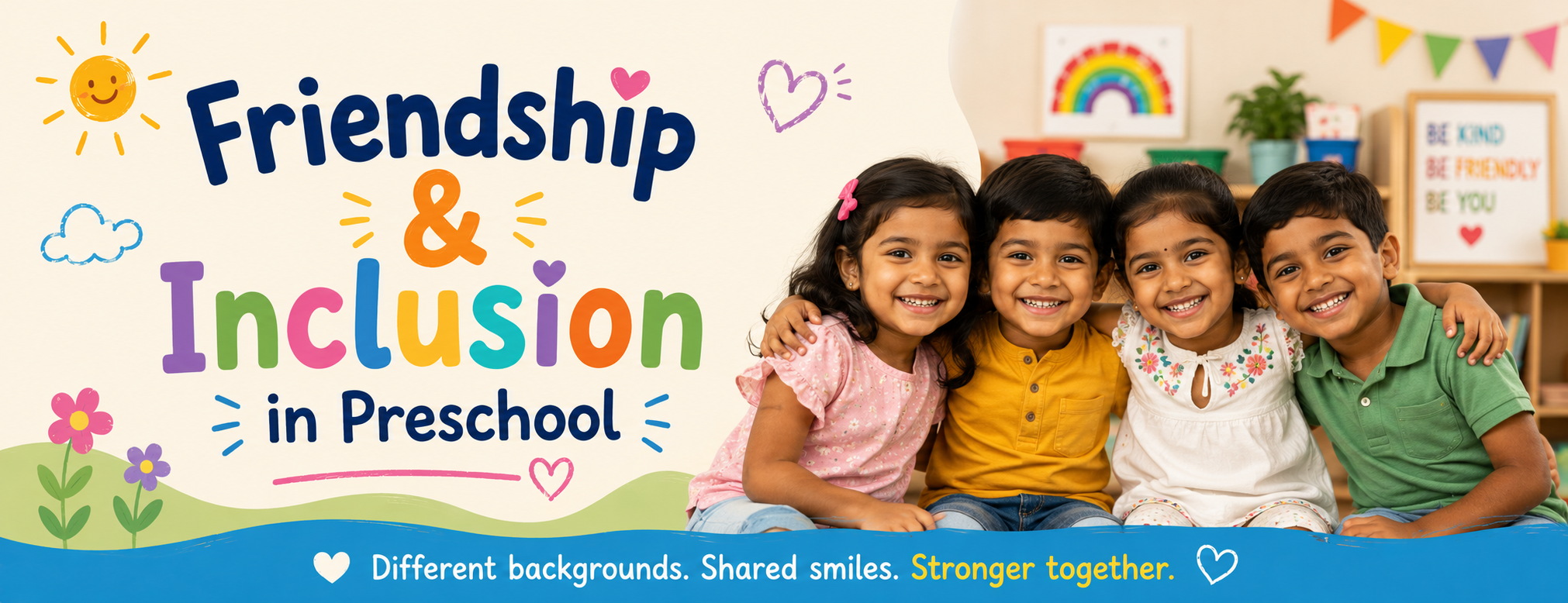
Social-Emotional Learning · Early Childhood · Best Play School in Ghaziabad
Building Friendships Beyond Differences: Why Preschool Must Teach Kindness, Diversity, and Belonging
Academic skills get children through exams. Social and emotional skills get them through life. Here is why the best play schools in Ghaziabad take friendship, inclusion, and empathy just as seriously as literacy and numeracy, and what it looks like when they get it right.
There is a moment most parents remember from their child’s first weeks at preschool. The moment when their child comes home and mentions another child by name for the first time. Not as someone they sat near, but as someone they played with. Someone they chose. That first named friend is a genuinely big deal, even if it does not look like one from the outside.
But friendship at preschool age is not just a social nicety. It is one of the most important developmental processes happening in a child’s early years. How children learn to form relationships, navigate differences, handle conflict, and extend kindness to people who are not like them shapes not just their childhood but the adults they will become.
The best play schools in Ghaziabad understand this and build social-emotional development into the fabric of every school day, not as an occasional lesson on being nice, but as a continuous, intentional part of how children are helped to grow.
A Child’s First Real Friendship
Before preschool, most children’s social world is defined by family. Siblings, cousins, and relatives they see regularly. These relationships are vital, but they are also given. The child did not choose them. Preschool is often the first place where a child chooses someone, and someone chooses them back.
That reciprocal choosing is where real social development begins. To keep a friendship, a child has to learn things that no parent can fully teach at home. How to share something they do not want to share. How to wait their turn without feeling forgotten. How to repair a relationship after a disagreement. How to include someone who is standing on the edges of a group looking uncertain.
These are not skills that come naturally to most young children. They have to be practiced, and they require an environment where the adults around them understand what is happening and help children through it rather than just redirecting conflict or ignoring it.
A child who learns how to be a good friend at three is building skills they will use at thirty. The ability to listen, to repair relationships, to extend trust, and to receive it generously are the foundations of every meaningful human connection that follows.
What Children Learn from a Diverse Classroom
Walk into any good preschool classroom in Ghaziabad and you will find children who come from different parts of the city, different kinds of families, and different cultural backgrounds. They celebrate different festivals, eat different food at home, and sometimes speak different languages with their grandparents. To an adult, these are significant differences. To a well-guided three-year-old, they are simply interesting.
Young children are not born with prejudice. They are born with curiosity. What they learn to do with that curiosity depends almost entirely on how the adults around them respond. A child who asks why their classmate’s lunch looks different and receives a warm, open answer learns that difference is something to explore. A child whose question is shushed or redirected learns that difference is something uncomfortable, something to be avoided rather than understood.
Preschool is the easiest window to shape this. Children at this age are genuinely open. They have not yet absorbed the social anxieties around difference that adults carry. A classroom that actively celebrates diverse stories, music, festivals, and food does not have to work hard to produce children who are curious and inclusive. It just has to not get in the way of what children naturally want to do, which is connect with each other.
Seeing Strengths Instead of Differences
One of the most quietly damaging things that can happen in a child’s early years is learning that their value is determined by how they compare to the child sitting next to them. Preschool children pick up signals from adults with remarkable sensitivity. When teachers and parents consistently frame performance as a competition, children begin to see their peers as rivals rather than companions.
A child who hears “why can’t you draw as nicely as Riya?” does not just feel bad in that moment. They begin building a mental model in which other children’s success is somehow a threat to their own. That model, once formed, is genuinely hard to undo.
The alternative is not the absence of standards. It is a different kind of standard. One where every child is measured against their own previous self rather than against the child beside them. “You drew that so much more carefully than last week” is both true and powerful. It gives the child something to build on rather than someone to beat.
Children who grow up in classrooms where individual growth is genuinely celebrated tend to be more generous toward their peers, more willing to try difficult things, and more emotionally secure. They are also, somewhat counterintuitively, more motivated. Because they are not risking humiliation every time they try something new.
Why Collaboration Matters More Than Competition
Competition is not inherently harmful. It can push people to try harder, to prepare more thoroughly, to care about doing their best. But at preschool age, competition is almost entirely counterproductive. Children at this stage are still figuring out their own identity. They do not yet have the emotional tools to lose gracefully, to handle comparison without distress, or to maintain friendships with people they are simultaneously trying to beat.
What they can do, with the right support, is collaborate. And what collaboration teaches is something that competition almost never does.
What children learn when they work together
When two children build a block tower together and it falls, neither of them failed. They had an experience together. When they figure out why it fell and try again, something genuinely important is happening: they are learning that setbacks are workable, that other people’s input is useful, and that the outcome of a shared effort belongs to both of them. These are lessons that follow children into every team, every partnership, and every workplace they will ever be part of.
Building Empathy: The Skill That Changes Everything
Empathy is probably the most talked-about quality in early childhood education right now, and for good reason. A child who can genuinely understand how another person feels, who can adjust their behaviour based on that understanding, is a child who will have fundamentally better relationships across every area of their life.
But empathy is often misunderstood as something children either have or do not have. In reality, it is a skill that develops through practice, and the practice happens in specific kinds of experiences. Hearing a story about a character who is sad and being asked “how do you think she feels right now?” is practice. Being guided through a conflict with a classmate by a teacher who asks both children how they felt is practice. Playing a character in pretend play who has a very different experience from your own is practice.
None of this requires a formal lesson or a structured programme. It requires adults who notice opportunities for empathy in the ordinary flow of the day and take a moment to explore them rather than moving on.
How Pretend Play Builds Social Understanding
When children play make-believe, they are doing something cognitively sophisticated. They are holding two realities at once: their own identity and the identity of the character they are playing. To do this well, they have to think about how someone else moves, speaks, makes decisions, and responds to other people. That is perspective-taking, and perspective-taking is the engine of empathy.
A child who spends time playing a shopkeeper has thought about what a shopkeeper wants, what problems a shopkeeper faces, and how a shopkeeper interacts with different kinds of customers. A child who plays a patient has experienced, imaginatively, what it feels like to need help and receive it. A child who plays a teacher has thought about how to explain something clearly to someone who does not yet understand it.
The social learning embedded in pretend play is enormous, and it happens without any adult instruction. What preschools need to provide is the time, the props, and the protected space for it to unfold. Children will do the rest.
Storytelling and the Characters Children Remember
Stories have been used to teach values for as long as people have been telling them, because they work. A child who hears a story about a character who is left out of a group and then included by one kind child does not just understand the concept of inclusion. They feel what it is like to be on both sides of that moment. That emotional resonance stays with them in a way that a direct instruction to “be kind” simply does not.
The most powerful storytelling in preschool is not the teacher reading from a book, though that matters too. It is the moment when children begin creating and telling their own stories. A child who invents a story where the smallest animal turns out to be the bravest is working something out. A child who includes every member of their friend group in their invented narrative is practicing belonging.
Child-led storytelling builds confidence, communication, and creativity. But it also builds character, because the values a child embeds in their own stories tend to reflect what they are genuinely learning to care about.
Puppets and the Things Children Find Hard to Say
There are things that are simply easier to say through a puppet than in your own voice. For young children, difficult emotions like loneliness, fear, anger, or the experience of being left out can be hard to articulate directly. The emotional weight of the experience can make the words feel stuck.
Puppets change this. When a child gives a puppet a name and a problem, they can explore that problem at a safe remove. The puppet can say “I feel sad when no one plays with me.” The child can say it too, through the puppet, and begin to process it. A skilled teacher can take that opening and create a conversation that would have been impossible without it.
Puppet play also models positive social behaviour in ways that feel playful rather than prescriptive. A puppet who apologises sincerely and gets forgiven is teaching conflict resolution. A puppet who notices that another character is left out and brings them in is teaching inclusion. Children absorb these demonstrations and, over time, begin to apply them in their own interactions without being told to.
Creating a Classroom Where Every Child Belongs
Belonging is not just a nice thing to have. For young children, the sense of being genuinely accepted and included is directly tied to their willingness to participate, take risks, and engage with learning. A child who does not feel they belong in a classroom will hold back. They will not raise their hand. They will not try the activity they are unsure about. They will not make the new friend sitting across from them.
Creating that sense of belonging requires more than good intentions. It requires classroom practices that are genuinely inclusive: making sure quieter children get to speak, making sure children who are new to the group are actively welcomed, making sure that acts of kindness are noticed and named rather than passing without acknowledgment.
It also requires teachers who catch the small moments. The child eating alone. The child who keeps getting chosen last. The child whose contribution to a group activity gets talked over. These are the moments that shape how children understand their own place in the world, and they happen quickly and quietly every single day.
How The Little Scholar Playschool Ghaziabad Builds It All In
At The Little Scholar Playschool in Kavi Nagar, Ghaziabad, social-emotional learning is not a programme that runs on certain days. It is the thread that runs through everything.
-
Daily Circle Time
Each morning begins with a group discussion. Children talk about how they are feeling, share something from their life, and practice the simple but important act of being listened to and listening in return. Over weeks and months, this consistent practice changes how children relate to each other.
-
Collaborative Learning Activities
Group projects, shared tasks, and cooperative games are built into the weekly routine. The goal is never to rank who contributed most. The goal is for children to experience the satisfaction of making something together that none of them could have made alone.
-
Role Play and Dramatic Play
Children regularly take on roles that are different from their own experience. A child who plays a community helper develops a different understanding of that person’s life. A child who plays a character from a story featuring a different culture begins to see that culture from the inside.
-
Storytelling with Diverse Characters
Stories are chosen and created to feature a wide range of characters. Children see themselves in stories and they see people who are different from them. Both kinds of recognition are valuable and both are intentionally provided.
-
Cultural Celebrations
The school marks festivals and traditions from across cultures throughout the year. Children bring something from their own family tradition to share with the class, and they receive something from every other family in return. This exchange creates genuine curiosity and respect.
-
Buddy Activities
Children are regularly paired with classmates they do not usually spend time with. New friendship combinations that would not have formed naturally are given a gentle nudge. Over a school year, this practice broadens every child’s social world considerably.
-
Recognition of Kindness
Acts of empathy, inclusion, and helpfulness are noticed and named by teachers in real time. “I saw you invite Aryan to join your game when he was standing alone. That was a kind thing to do.” These moments matter enormously. Children repeat the behaviours that get genuinely noticed.
The school’s approach is grounded in the understanding that character is not built through lessons about character. It is built through the daily experience of living in an environment where kindness is practiced, celebrated, and expected as normal. Read what Ghaziabad families say about this on their Google Business profile.
What Children Who Learn This Way Carry Forward
The values that children absorb in their preschool years tend to be remarkably durable. Not because they were memorised, but because they were lived. A child who experienced genuine inclusion in their classroom, who had the experience of belonging and of helping others to belong, carries that forward.
Stronger Relationships
Children who learn to build and repair friendships early form healthier relationships throughout life.
Better Communication
Children who practice expressing themselves and listening to others become clearer, more empathetic communicators.
Cultural Awareness
Exposure to diversity early produces adults who are genuinely comfortable in diverse environments.
Leadership Qualities
Children who learn to include, to notice, and to uplift others naturally grow into people others want to follow.
Looking for the Best Play School in Ghaziabad?
If you want a preschool where your child grows academically and as a person, where kindness and friendship are taken as seriously as letters and numbers, the team at The Little Scholar Playschool Kavi Nagar is happy to help.
Frequently Asked Questions
Why are friendships important in preschool?
Preschool friendships are often a child’s first meaningful relationship outside the family. They teach sharing, listening, conflict resolution, and empathy through real daily experience. Children who develop genuine friendships in their early years tend to be more emotionally resilient, more socially confident, and better prepared for the relational demands of formal schooling.
How does the best play school in Ghaziabad teach inclusion and diversity?
The Little Scholar Playschool in Kavi Nagar, Ghaziabad builds inclusion through daily circle time discussions, storytelling with diverse characters, cultural celebrations, buddy activities, collaborative projects, and the consistent recognition of kindness in the classroom. These are not occasional events. They are part of how every ordinary day runs.
Why should children not be constantly compared to each other?
Excessive comparison at an early age teaches children that their worth is relative to others, which creates anxiety, erodes confidence, and damages friendships. Children develop more healthily when adults focus on individual growth and genuine effort. The goal is for each child to become the best version of themselves, not to outperform whoever is sitting next to them.
How does pretend play support friendship building?
Pretend play naturally requires children to communicate, negotiate, share ideas, and cooperate in order for the imaginary scenario to work. Taking on different roles also builds empathy, because children begin to understand how other people think and feel from the inside. This is one of the most powerful and natural forms of social learning available to young children.
What is social-emotional learning and why does it matter in preschool?
Social-emotional learning is the process through which children develop the ability to understand and manage their own emotions, build and maintain relationships, and make responsible decisions. Research consistently shows that children with strong social-emotional foundations perform better academically, form healthier relationships, and are better equipped for the challenges of adult life.
What makes The Little Scholar the best play school in Kavi Nagar Ghaziabad?
The Little Scholar Playschool in Kavi Nagar, Ghaziabad treats character development, friendship, and social-emotional learning with the same seriousness as early academics. These values are woven into every day rather than added as occasional extras. With decades of experience and a team of genuinely warm and experienced teachers, the school is widely regarded as one of the best play schools in Ghaziabad. You can read parent reviews on their Google profile.
How does collaborative learning benefit young children?
Collaborative learning teaches children that other people’s ideas and contributions have value. It develops listening skills, flexibility, shared problem-solving, and the experience of collective success. These are skills that follow children into every team, every classroom, and every workplace they will ever be part of.
Why is puppet play used in social-emotional learning for young children?
Puppets allow children to explore difficult emotions and social situations at a safe remove. Many children find it easier to express feelings of loneliness, fear, or conflict through a puppet character than through direct conversation. Puppet play also models positive behaviour like apologising, forgiving, and including others, in a way that feels playful rather than instructional.
The Child Who Knows How to Be a Friend
In the end, one of the most meaningful things a preschool can do for a child is to help them understand that other people matter. That the child sitting across from them has a life, a family, a set of experiences, and a set of feelings that deserve genuine curiosity and care. That kindness is not a performance. It is a way of being in the world.
Children who learn this early carry it with them. Into classrooms, playgrounds, friendships, and eventually into workplaces and communities and families of their own. The child who learned to include someone standing on the edges of a group at age four will do it again at fourteen, and forty. The lessons that take root in those early years run deep.
For parents in Ghaziabad looking for the best play school in Kavi Nagar Ghaziabad that understands this, the conversation is worth having. The difference between a school that teaches children facts and a school that helps them become genuinely good people is measurable. And it starts at three years old, in a classroom, in the ordinary moments between the lessons.