
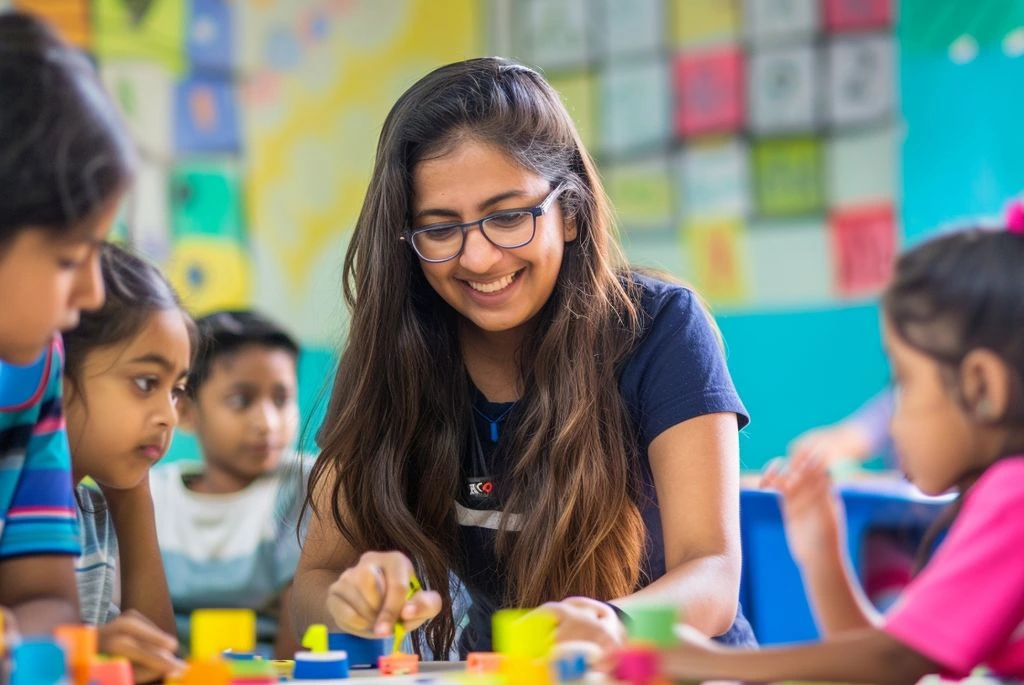
A child’s first experience of school is rarely shaped by what is taught. At Little Scholar Ghaziabad, the more telling factor is how children are allowed to arrive into the day. Some move quickly toward activities. Others take time. No one is hurried into readiness. That choice, small as it appears, reveals how seriously the early years are taken.
Parents researching schools are often flooded with claims about learning outcomes. What is discussed far less is how learning is allowed to happen. The real value of early education sits in that space. Understanding the early childhood education meaning requires looking past curriculum lists and into daily practice.
Young children are not miniature students. They do not process information through instruction alone. They learn through repetition, physical movement, and emotional response. When a child returns to the same activity repeatedly, they are not avoiding challenges. They are working something through. Schools that interrupt this process in the name of visible progress often undermine learning rather than accelerate it. This distinction is central to the early childhood education meaning, though it is rarely articulated clearly.
Much of early learning happens before children speak confidently. Tone of voice, pace of the day, and adult reactions shape how children interpret their environment. A calm response to hesitation communicates safety. A rushed correction communicates urgency. Over time, these signals influence whether a child approaches learning with curiosity or caution. This is where the early childhood education meaning becomes practical rather than theoretical.
Play is often misunderstood as informal or secondary. In reality, it is the primary way young children organise information. Through play, children test boundaries, experience frustration in manageable doses, and practise social interaction without formal rules. These experiences build emotional control and adaptability. When play is overly directed or reduced, children may appear busy, but their learning becomes shallow. Respecting play is not a philosophical choice. It is a functional one, and it sits firmly within the early childhood education meaning.
Another aspect parents frequently overlook is emotional regulation. Children are not born knowing how to wait, share attention, or recover from disappointment. They learn these skills gradually, through consistent adult behaviour. Teachers who respond predictably and calmly provide a framework children rely on. Over time, this consistency allows children to manage themselves with less external support.
Parents usually notice the results indirectly. Children begin following routines at home without prompting. They attempt tasks independently. They explain feelings rather than acting them out. These changes are not sudden, and they are not academic. They indicate internal organisation, one of the most important outcomes of early learning.
For parents evaluating schools, the most useful questions are often the simplest. How does the day begin? What happens when a child hesitates? How are transitions handled? The answers to these questions clarify early childhood education meaning far more effectively than any stated philosophy.
Early education done well is quiet. It does not seek attention. It builds capacity. And that capacity stays with children long after the early years are over.