
Parenting · Early Childhood · Best Play School in Ghaziabad
Why Keeping Preschoolers Engaged in Learning & Activity Classes Beyond School Matters More Than Ever
The childhood most of us grew up with barely exists any more. Wide streets full of children, endless afternoons of free play, cousins in and out of the house. Today’s children live in a different world, and the things they once absorbed naturally now have to be built deliberately. Here is what that means for parents in Ghaziabad, and why it matters.
Every parent today wants the best for their child. The right preschool. Good food. Educational toys. A safe environment where they can grow up healthy and happy. And yet, despite all of this, one quiet loss has crept into modern childhood that most parents feel but rarely name. Children today have far fewer chances to learn from ordinary life than any previous generation did.
A generation ago, a child could pick up almost every important life skill just by being present. Watching a grandmother in the kitchen. Walking to the market with a father. Playing on the street until the streetlights came on. Solving a fight with the neighbourhood kids without any adult stepping in. Nobody called any of this “learning”. It was just life.
Today’s children live in a world where much of that has disappeared. Apartments have replaced open neighbourhoods. Screens have replaced streets. Busy schedules have replaced long, unstructured afternoons. This is not anybody’s fault. It is simply the world we now live in. But it does mean that the experiences previous generations received automatically are now things we have to create for our children on purpose.
Are We Raising Children for Marks or for Life?
Somewhere in the last two decades, education started to feel like a race. Better schools, more classes, higher scores, earlier academic starts. Parents are told constantly that their child needs to be ahead, and the anxiety this creates is very real. But it is worth stepping back and asking a harder question. What kind of adult are we actually trying to raise?
Marks are useful. School matters. But nobody who has raised a child would say that a report card is the full measure of who their child is. What we actually want, when we are being honest, is a child who is curious, confident, kind, resilient, and genuinely engaged with the world. These are not qualities that get built through worksheets. They get built through experiences, relationships, and the small daily moments that add up over years.
This is why parents looking for the best play school in Ghaziabad are increasingly asking a different set of questions. Not just what the child will learn academically, but what kind of environment they will be immersed in for these formative years. And what happens in the hours outside school hours has become just as important as what happens inside.
The Childhood We Grew Up With vs Today
Before we get into what to do about it, it is worth being clear about what has actually changed. This is not nostalgia. It is a real, measurable shift in how children spend their time.
One Generation Ago
Life was the classroom
Children played on streets, ran errands with parents, ate at grandparents’ homes, joined cousins in games no adult organised, argued with neighbours’ kids and made up an hour later, and learned resilience by simply being outside for hours every day.
Today
Life is more structured
Children live in apartments, spend more time indoors, have fewer siblings and cousins nearby, encounter fewer strangers as part of daily life, and interact with more screens than people during large parts of their week.
The point of this comparison is not to say that one is good and the other is bad. Every era has its own advantages. Today’s children are safer in many ways, have better nutrition, better healthcare, and access to information their grandparents could not have dreamed of. But something has been lost too, and pretending otherwise does not help our children.
Try to recall a favourite memory from your own childhood. For most of us, it is not sitting in a classroom or unwrapping a new toy. It is a specific afternoon with cousins, a game that went on too long, a moment with a grandparent, a day when nothing planned happened but everything felt right. These memories are made of unstructured time and human connection. That is the currency of childhood, and it has been running low.
Why Preschool Alone Is No Longer Enough
A good preschool is essential. It builds the foundation for literacy, numeracy, communication, and early social skills, and children who attend a warm and thoughtful preschool tend to start formal schooling significantly stronger than those who do not. This is not in question.
But the hours a child spends at preschool are a small fraction of their day. Between 2 and 6 years old, a child’s brain is developing faster than at any other time in their life. Every waking hour, connections are being formed based on the experiences the child is having. Movement, conversation, creativity, exploration, sensory experiences, and relationships. All of this is shaping who the child is becoming.
Those hours outside preschool matter enormously. And this is precisely where many well-intentioned parents run into difficulty. They know their child needs more than school. They just do not always know what “more” should look like, or how to fit it into an already full family life.
The years between 2 and 6 are often called the golden years of learning. This is not marketing language. It reflects real research on brain development. What children experience during these years shapes them more deeply than most parents realise. The goal is not to overload them. The goal is to make sure the ordinary hours of their days are rich in the kinds of experience their brain is designed to grow from.
Seven Reasons Activity Classes Matter More Now Than Ever
Activity classes and thoughtfully chosen experiences beyond preschool have gone from being a nice-to-have to being genuinely important. Here is why.
-
1
Modern Parenting Has Less Room for Natural Learning
Both parents work. Grandparents often live in different cities. Commutes are long. Even when parents are physically at home, phones and laptops are usually nearby. This is nobody’s fault, but it does mean that the informal learning that used to happen just from being around adults is now less available.
A previous generation of children learned patience by waiting in queues with their mother, learned negotiation by dealing with a shopkeeper, learned respect by watching neighbours help each other. Well-chosen activities help fill the gap by teaching these same qualities in a slightly different form.
-
2
Neighbourhood Play Barely Exists
Ask any adult over 30 to describe their favourite childhood games. Stapu. Pakdam Pakdai. Kho Kho. Cricket in the streets. Hide and seek that went on for hours. None of it required expensive equipment. All of it built negotiation, leadership, conflict resolution, empathy, and lasting friendships.
Today, most children live in gated societies where neighbours do not know each other well and street play has largely disappeared. Activity classes provide something increasingly rare: a community of peers who share an interest. Whether it is dance, football, music, or robotics, that shared community teaches children something no isolated activity can. That learning is more meaningful when it is shared.
-
3
Children Need Exposure Before They Can Discover Their Passion
A five-year-old cannot possibly know whether they love painting, music, storytelling, sports, science, or something else entirely. Passion develops through exposure. The purpose of early classes is not to produce professional dancers or musicians. It is to give children the chance to try many things and notice what excites them.
The most important discovery of the early years is often not academic. It is the moment a child realises they light up when they play music, or run, or draw, or build. That kind of self-discovery is only possible if children are given the opportunity to try things and see how they feel.
-
4
Too Many Toys, Too Few Playmates
Modern children often have more toys than any previous generation. Educational toys, battery-operated toys, building blocks, apps and games. Some of these are genuinely useful. But a child surrounded by things and short on playmates is often lonelier than we realise.
Toys cannot teach sharing, compromising, waiting, forgiving, or celebrating together. Only other children can. Activity groups quietly remind children that people matter more than possessions, which is a lesson that becomes more important, not less, as they grow up.
-
5
Transitions Are a Skill Children Have to Learn
Every parent has watched their child melt down when asked to stop one activity and start another. This is completely normal. But learning how to transition smoothly is one of the most important life skills a young child can develop.
Structured activity classes teach transitions naturally. Circle time gives way to music, then to snack, then to outdoor play, then to pack up. Each transition is a small opportunity to practice flexibility, self-regulation, and time awareness. Over months, children who move through these routines become noticeably better at managing their own attention and emotions, which pays off enormously in school and beyond.
-
6
Preschool Years Are the Best Time to Build Foundational Skills
The brain in these years is designed to absorb. Music, movement, storytelling, sport, art. Each of these builds specific abilities that stay with a child for life. Children this age also have significant energy that needs somewhere to go. When that energy finds meaningful outlets, behavioural challenges tend to reduce while confidence grows.
The choice is not between “keeping children busy” and “leaving them alone”. It is about making sure that some of the hours in their week are spent on activities that genuinely nurture different aspects of who they are becoming.
-
7
The Definition of Success Has Changed
For decades, children have grown up hearing the same question. “What will you become? A doctor or an engineer?” But the world our children will live in has expanded dramatically. Today’s successful adults include designers, entrepreneurs, content creators, chefs, animators, musicians, therapists, athletes, environmental scientists, teachers, and dozens of other honest professions.
Exposing children to different skills, and letting them meet adults who work in different fields, teaches them something important. That every profession contributes something. That success has many shapes. That being good at one thing does not mean being better than someone who is good at another. These are lessons that shape not just career choices, but character.
The Hidden Benefits Parents Often Miss
Beyond the visible skills a child picks up from any given activity, there are quieter qualities that develop over time and often matter more in the long run. These are the qualities that report cards cannot measure but that determine much of what happens in a person’s life.
-
✓
Growing independence and the belief that they can figure things out for themselves
-
✓
Clearer, more confident communication in both familiar and unfamiliar settings
-
✓
Emotional resilience, the ability to bounce back after setbacks or disappointment
-
✓
Genuine curiosity, a willingness to ask questions and pursue what interests them
-
✓
Creative thinking, the ability to imagine solutions rather than wait to be told what to do
-
✓
The confidence to speak up in a group and the humility to listen when someone else does
-
✓
Empathy for peers, teachers, and eventually the strangers they will encounter throughout life
-
✓
A sense of responsibility that begins with small tasks and grows over years
Different Activities Build Different Strengths
Not every activity does the same thing. This is worth knowing when you are choosing what to enrol your child in. A good mix over time exposes children to a range of experiences that develop different parts of who they are.
Music
- Sharpened listening
- Memory and rhythm
- Concentration and focus
- Emotional expression
Dance
- Body coordination
- Physical confidence
- Fitness and stamina
- Comfort with performance
Sports
- Teamwork under pressure
- Resilience after losing
- Leadership and roles
- Physical strength
Art
- Creativity and imagination
- Fine motor skills
- Colour and pattern sense
- Emotional expression
Storytelling
- Rich vocabulary
- Sequencing skills
- Imagination
- Public speaking confidence
Science Activities
- Natural curiosity
- Observation skills
- Logical thinking
- Problem solving
Children are naturally energetic. They are designed to move, explore, and create. When that energy finds meaningful outlets across a range of activities, everything else in their life tends to improve. Sleep, appetite, behaviour, and even academic focus all benefit when a child feels genuinely stretched and satisfied by their week.
Choosing the Right Activities Without Overloading
Here is where many parents accidentally do too much. In their genuine desire to give their child every opportunity, they enrol them in something every day, and the child ends up exhausted, over-scheduled, and less able to enjoy any of it. This is a real risk, and it undermines the whole point of what activity classes are supposed to do.
A balanced week for a young child includes
For most preschool-aged children, one or two well-chosen structured activities per week alongside their regular school routine is more than enough. The rest of the week should have space for free play, family conversations, outdoor time, and honestly, some boredom. Boredom is not the enemy. It is often where creativity is born.
The measure of a good week is not how full the schedule is. It is whether the child comes home each day looking tired in a good way. Genuinely engaged, still smiling, and looking forward to the next day. If a child seems worn out, cranky, and dreading their classes, something needs to be adjusted.
What Parents Can Do at Home
The most powerful learning environment is not any activity class. It is home. What a parent does day to day shapes their child more than any external programme, and the good news is that most of it does not require anything special.
-
📖
Read together every day. Even ten minutes. The single most powerful thing you can do for your child’s language, imagination, and love of learning.
-
🌳
Encourage outdoor play whenever possible. A park, a garden, a walk. Fresh air and unstructured movement do things nothing else can.
-
🏠
Involve them in small household tasks. Watering plants, folding towels, setting the table. Real participation builds real confidence.
-
🍳
Let them help in the kitchen. Washing vegetables, stirring, measuring. Kitchen learning is science, maths, and life skills all at once.
-
📱
Reduce passive screen time. Not eliminate, but reduce. Every hour of screen replaced with almost anything else pays dividends.
-
🏛️
Visit parks, museums, and libraries. Even occasionally. New environments feed a young mind more than a new toy ever will.
-
❓
Answer their questions patiently. The child who asks a thousand “why” questions is showing exactly the kind of mind we want to encourage.
-
👋
Introduce them to different people and professions. Chefs, artists, mechanics, farmers. The world becomes bigger and more interesting.
-
👫
Arrange playdates with friends. Peer relationships outside school hours are increasingly rare and increasingly valuable.
-
🌤️
Allow boredom occasionally. It is often the doorway to imagination. Do not rush to fill every empty moment.
The truth is that children do not need perfect parents. They need present parents. Parents who create the small daily opportunities for connection, curiosity, and shared experience that shape a childhood into something worth remembering.
How The Little Scholar Playschool Ghaziabad Fits In
A good preschool does much more than teach the alphabet and numbers. It builds an environment where children learn to make friends, express their feelings, solve problems, explore creativity, respect diversity, and above all, actually enjoy learning. That environment shapes children as powerfully as any structured activity outside school.
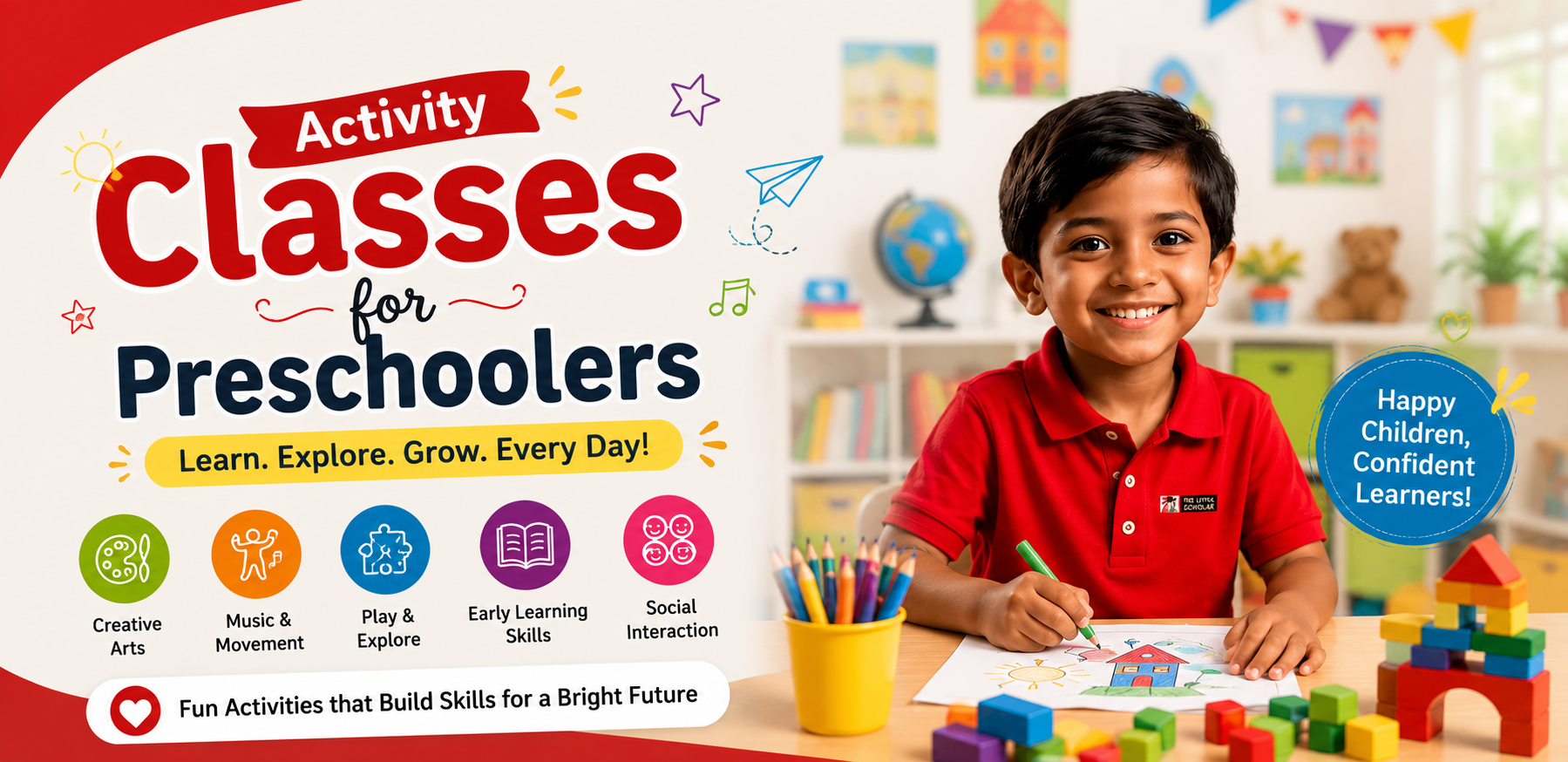
At The Little Scholar Playschool in Kavi Nagar, Ghaziabad, this understanding is at the heart of the approach. The school does not treat academics, life skills, activities, and social development as separate departments. It weaves them together into a daily experience that helps children grow across every dimension of who they are becoming. Music, storytelling, dance, art, structured play, outdoor activity, and the ordinary rhythm of classroom life all combine to give children exactly the kind of rich, joyful experience their brain is designed to grow from.
Parents looking for the best play school in Ghaziabad often mention this integrated approach as one of the main reasons they choose The Little Scholar. It is not that the school has more activities than others. It is that the activities are woven into a coherent philosophy that treats every hour of the school day as an opportunity to shape a whole child, not just a student.
You can read what families across Ghaziabad say on their Google Business profile.
Ready to Give Your Child the Best Start?
If you want a preschool that goes beyond books and builds the kind of confident, curious, capable child you dream of, the team at The Little Scholar Playschool Kavi Nagar is happy to help. Book a school visit or fill the admission inquiry form.
Frequently Asked Questions
Is it necessary for preschool children to attend activity classes apart from school?
Yes, but with balance. A preschool provides the foundation for academic and social learning, while extracurricular activities nurture creativity, confidence, teamwork, and emotional intelligence in ways that complement classroom learning. The best play schools in Ghaziabad often build many of these activities into the school day itself, but additional exposure outside school still adds real value when chosen thoughtfully.
At what age should a child start extracurricular activities?
Children can begin age-appropriate activities as early as 2.5 to 3 years old. Music, dance, storytelling, sensory play, art, swimming, and creative movement are excellent starting points. They support brain development while keeping learning joyful. The goal at this age is exposure and enjoyment, not skill mastery.
Can too many classes overwhelm a preschooler?
Yes. One or two well-chosen activities each week is more than enough for most preschool-aged children. What matters far more is that children still have time for free play, outdoor movement, family conversations, and rest. Over-scheduling can actually reduce a child’s enjoyment of learning rather than build it.
How do extracurricular activities improve academic performance?
Activities like music, sports, art, and storytelling strengthen memory, concentration, listening, language development, and problem-solving. These foundational skills make it significantly easier for children to adapt to formal schooling and perform better academically. The connection between activity engagement and academic outcomes is well-documented.
My child is shy. Will activity classes help?
Yes, particularly if the classes are warm and unpressured. Participating in group activities gives shy children regular opportunities to communicate, share, and make friends in a low-stakes environment. Over time, most shy children become noticeably more comfortable expressing themselves. The key is choosing classes where teachers are patient and understanding rather than performance-focused.
Are experiences more valuable than educational toys?
Educational toys have their place, but experiences create deeper and longer-lasting learning. A toy can teach a concept, but interacting with other children in a shared activity teaches empathy, teamwork, patience, leadership, and emotional intelligence. These are skills toys cannot build. This is why memories from childhood are almost always about experiences and people, rarely about possessions.
How many activities should a preschool child attend each week?
Most preschoolers benefit from one or two structured activities per week in addition to their regular school routine. Quality matters more than quantity. Parents should ensure children still have plenty of time for free play, rest, and family bonding, which are just as important developmentally as any structured class.
Why should children explore different activities instead of specialising early?
Early childhood is a time for exploration. Exposure to music, dance, sports, science, art, and creative play allows children to discover their own natural interests and strengths. Specialising in one career-focused activity too early can limit a child’s opportunities to develop a wide range of skills and often forecloses discoveries they might have made later.
How do activity classes help children make friends?
Modern children often have fewer opportunities to play with neighbourhood friends than previous generations. Hobby classes introduce children to peers with similar interests, helping them build friendships, learn cooperation, and develop a sense of belonging within a community. For children in apartment complexes with limited neighbourhood interaction, this is genuinely important.
What should parents look for while choosing the best play school in Ghaziabad?
Look for a school that prioritises holistic development over rote learning. That means a safe and nurturing environment, qualified and warm educators, strong communication with parents, age-appropriate extracurricular activities, opportunities for creative expression and outdoor play, and a curriculum that builds confidence, curiosity, and life skills, not just academic knowledge. The Little Scholar Playschool in Kavi Nagar is widely regarded as one of the best play schools in Ghaziabad for exactly this integrated approach.
The Goal Is Not Busyness. The Goal Is Becoming.
The world our children will inherit is changing faster than any of us can predict. Many of the jobs they will eventually do do not even exist today. Academic excellence will always matter, but the qualities that will most define whether they thrive as adults, creativity, adaptability, empathy, curiosity, and confidence, are qualities that are built now, in these early years, through the sum of every experience they are given.
That is why thoughtfully chosen learning experiences beyond preschool are no longer a luxury. They are one of the most valuable investments a family can make in a child’s future. Every music session, every art project, every sports class, every story circle, and every opportunity to make a new friend contributes to who this child is becoming.
The goal is not to keep children busy. The goal is to help them become kind, capable, confident, and curious human beings who are prepared not just for school, but for life. Every child deserves that. Every family in Ghaziabad has the opportunity to give it.