
Parenting · Emotional Wellbeing · Best Play School in Ghaziabad
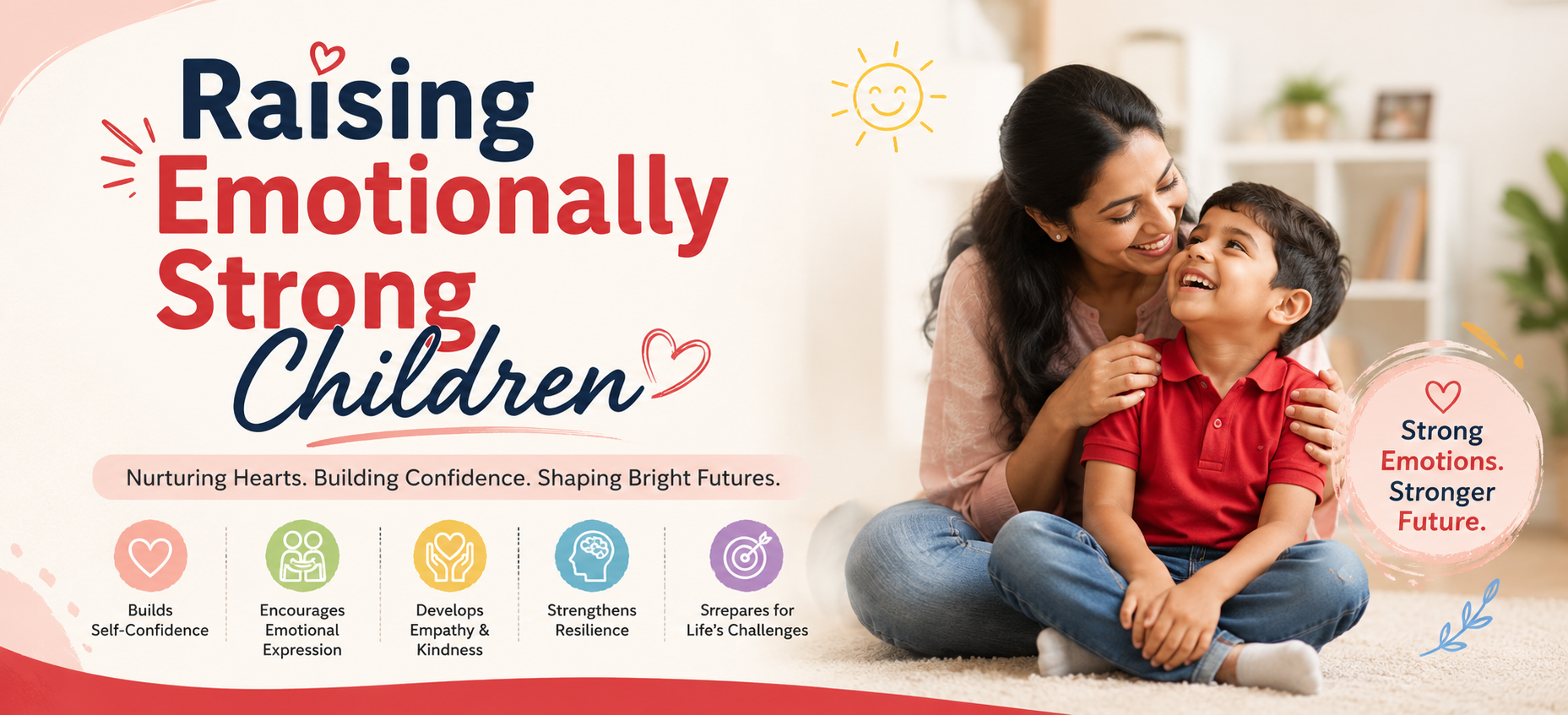
Beyond Marks and Examinations: Raising Emotionally Strong, Resilient, and Compassionate Children
The news these days makes every parent worry. Academic pressure, student stress, tragic headlines. The question is no longer just how do we help our children score more. It is how do we help them become stronger human beings, starting from the preschool years.
Education is not the learning of facts, but the training of the mind to think and the heart to care.
Almost every parent I have spoken with in the last year has, at some point, been shaken by something they read in the news. A story about a student who could not cope with the pressure. A headline about an exam controversy. A conversation among relatives about a family somewhere that is grieving because a child made a terrible decision they should never have had to make. These stories stay with us. They should.
Every Parent Is Feeling It
The academic pressure that today’s children face is real, and it is heavier than what most of us experienced. Even those of us who thought school was intense in our own time are looking at what our children navigate now and finding it hard to compare. Add to that the anxiety around mental health, bullying, and the constant hum of comparison that social media brings into the picture, and it makes sense that parents are asking themselves harder questions than any previous generation had to.
The questions parents keep asking themselves
Will my child be able to handle the pressure that lies ahead?
How do I make sure they never lose hope?
How can I prepare them for a world that sometimes feels increasingly unforgiving?
These are not questions with easy answers. But they are the right questions, and the fact that so many parents are asking them is genuinely a good sign. It means we are thinking about our children’s wellbeing more deeply than the previous generation often did. The next step is understanding what the answer actually looks like in practice, especially when your child is still very young.
The Foundations Are Built Long Before Board Exams
Here is something worth internalising. Almost all the headlines that trouble us involve teenagers or older students. The tragedies, the burnout, the moments when a child feels they cannot go on. These are stories about older children, and it is tempting to think that the work of preparing children to handle pressure begins in adolescence.
It does not. The truth is that the emotional foundations a child needs to face life’s difficulties are built years earlier. Resilience, self-belief, the ability to ask for help, the capacity to be kind to themselves after failure. All of these begin taking shape long before a child ever sees a report card. They begin in the preschool years, in the small daily moments of a two or three or four-year-old’s life.
This is not a comfortable thought for parents of teenagers, because we cannot go back. But it is a genuinely hopeful thought for anyone with a young child right now. The habits of emotional strength are still being written. What we do in these years matters, and it matters much more than most people realise.
The Question We Should Be Asking
Most conversations about children’s education revolve around a single, deeply embedded question. “How can we help our child score higher?” It is a fair question. Every parent wants their child to succeed academically. But when we ask only this question, we accidentally teach our children that scoring is the point of education, and that their worth as a person is somehow bound up in a number.
The better question, and the one we should be asking as parents and as educators, is: How can we help our child become a stronger human being? A child who believes in themselves can survive academic setbacks. A child who feels genuinely loved rarely believes they are alone. A child who knows their own worth understands that one exam, one mistake, one difficult phase can never define who they are.
At The Little Scholar Playschool in Kavi Nagar, Ghaziabad, this shift in the question is at the centre of everything. The school is not trying to build children who score well. It is trying to build children who are strong. Children who love learning because it feels safe. Children whose confidence does not collapse when something goes wrong. Children who know how to reach out when they need help and know they will be met when they do.
Why Resilience Should Come Before Reading and Writing
Imagine two trees. One grows in a protected greenhouse where the temperature is perfect, the water is measured, and no wind ever touches its leaves. The other grows outside, exposed to sun and rain, occasional cold, and the everyday winds that shape a tree’s life. Which one develops stronger roots?
The Greenhouse Tree
Grows quickly in perfect conditions. But its roots stay shallow because they never had to search for water or grip harder against wind. When something changes, it struggles.
The Open Tree
Grows more slowly, exposed to changing weather. But its roots go deep, its trunk bends without breaking, and it can weather almost anything the world throws at it.
Children are no different. The goal of a healthy childhood is not to remove every difficulty from a child’s life. That is not possible, and it would not be good for them even if it were. The goal is to gradually help them develop the belief that they can handle the difficulties that come. That belief is what resilience actually is.
Resilience is not the absence of sadness or fear. It is not toughness in the “I don’t cry” sense. Resilience is the quiet conviction that “this feels hard, but I can get through it.” That conviction is built in the earliest years of life through loving relationships, meaningful experiences, and environments where children feel emotionally safe. When children develop resilience, they can handle disappointments, adapt to change, form healthy friendships, manage stress, and bounce back after failure. These qualities matter far more than marks alone.
Helping Children Become Strong Enough to Face Setbacks
Every child will face setbacks. Maybe they won’t be picked for a competition. Maybe a friend will suddenly stop wanting to play. Maybe they will lose a race. Maybe they will not understand something their classmate finds easy. These moments happen throughout childhood, and they are not disasters. They are the raw material from which resilience is built, if we let them be.
Here is where many well-meaning parents accidentally get in their own child’s way. When something goes wrong, our instinct is to fix it. To smooth it over. To make the discomfort go away. This comes from love. But repeated too often, it teaches children that they are not capable of dealing with hard things themselves. That someone else will always step in. And that message, absorbed over years, becomes genuinely limiting.
The alternative is to become a coach rather than a rescuer. When your child comes to you with a problem, try to resist the urge to solve it. Try these questions instead.
- “What do you think happened?”
- “How does it make you feel?”
- “What could we do differently next time?”
- “Who could help us with this?”
- “What did you learn from this?”
These questions do something important. They tell the child, without saying it directly, that they are capable of thinking about the situation themselves. Over time, they learn that problems have solutions, that mistakes are opportunities to learn, and that asking for help is a sign of strength rather than weakness. All of these lessons make them stronger for what comes later.
How Emotional Strength Is Actually Built
Resilience does not come from motivational talks or big life lessons delivered on serious occasions. It grows quietly, in the small everyday moments of a child’s life. Every time a child manages to do something difficult on their own, a whisper goes off inside them: “I can do hard things.” That whisper becomes their inner voice. And when the pressure of school and life eventually arrives, that voice is what carries them through.
-
✓
Letting them try to tie their own shoelaces even when it would be faster to do it yourself.
-
✓
Helping to set the dining table and being trusted with real plates and glasses (not just toys).
-
✓
Being responsible for watering a plant that will actually die if they forget, and seeing it thrive when they remember.
-
✓
Waiting patiently for their turn in a game or a queue, even when it is genuinely hard.
-
✓
Losing a board game without being allowed to win as a rescue, and learning to enjoy playing anyway.
-
✓
Working on a puzzle without an adult jumping in with the answer at the first sign of frustration.
-
✓
Making small choices about what to wear, what to eat, what to do next, and feeling the weight of being taken seriously.
None of these moments look important. But layered on top of each other, day after day, week after week, they build a child who genuinely believes they are capable. That belief is the single most valuable thing you can hand your child before they face the pressures of formal schooling.
Schools Must Value Every Child, Not Just Every Report Card
One of the most important things a school can do for a young child is help them feel that they belong. Not as a top scorer, not as an underperformer, not as anything comparative. Just as themselves. This sounds obvious, but it is remarkably easy for schools to fall short of it without realising.
Children pick up on adult signals with startling sensitivity. If praise is reserved for the highest scorers, if attention flows most freely to the fastest readers or the neatest writers, children begin to absorb a message: love and appreciation have to be earned by performance. That is not education. That is emotional conditioning, and it plants the exact anxiety that later shows up as teenage burnout.
The alternative is a school where every child brings their own thing and every thing is genuinely valued. Consider what a good preschool sees:
One child sings beautifully
Music and rhythm come to her as naturally as breathing.
Another comforts a crying friend
Empathy shows up in him before anyone thought to teach it.
One asks thoughtful questions
The kind adults have not thought of, from a mind clearly working.
Another patiently helps classmates
She notices who needs help before the teacher does.
One is curious about nature
Insects, leaves, and clouds hold his attention for hours.
Another builds structures
Extraordinary things with blocks, from a mind that sees space differently.
Should only one of these strengths be celebrated? Of course not. Every child deserves to feel seen. In practice this means teachers who greet every child warmly by name each morning, who celebrate effort as much as achievement, who encourage participation over perfection, who give every child opportunities to lead in different ways, and who recognise acts of kindness alongside academic milestones.
The words teachers use quietly shape a child’s identity. “Thank you for helping your friend.” “I love how patiently you waited.” “You kept trying even when it was hard.” “You were very thoughtful today.” Children who hear these things repeatedly start to believe them about themselves. They begin thinking: I am helpful. I am kind. I don’t have to be perfect to be appreciated. Those beliefs stay with them for the rest of their lives.
Teaching Children That Life Is Bigger Than Marks
Every parent wants their child to succeed. There is nothing wrong with encouraging excellence. The problem begins when children start believing, without anyone ever explicitly saying it, that their marks decide their worth. No report card should ever carry that much weight. But children absorb this belief when the way adults respond to their performance is dramatically different from how they respond to everything else about the child.
The messages children need to hear from parents, and from teachers, cannot be delivered only once. They have to be repeated across years, in different words and different tones, until they become part of how the child understands themselves.
Success should never come at the cost of hope. When children understand that their identity is larger than their academic performance, they become more willing to take healthy risks, learn from failures, and keep moving forward. Hope is one of the greatest gifts adults can give children. And once given, it is one of the hardest things to take away.
Helping Children Build a Caring Community
One of the biggest quiet changes in modern childhood is that many children now grow up in smaller families with fewer natural opportunities to interact with cousins, neighbours, and extended family. In earlier generations, a child was surrounded from birth by a rotating cast of people who all felt like theirs. Today, many children spend their weekdays largely alone with their parents. This is not anyone’s fault, but it does mean that preschool has become an important social space in a way it never was before.
A classroom should not just be a place where twenty children happen to sit together. It should be a community. A place where every child walks in knowing that if they are sad today, someone will notice. If they need help, someone will listen. If they fall, someone will help them get up. This kind of emotional safety is what allows children to learn, take risks, and grow with confidence.
Classroom practices that build genuine community
Children learn what community means by living in one. When teachers actively create traditions that pull children into shared experiences, and when they consistently notice and name acts of kindness, children begin to understand something powerful. That being part of a group is not just about being present. It is about looking out for the people around you, and being looked out for in return.
Sometimes, all it takes to change a lonely child’s day is one invitation to play. One smile from a peer. One friend saying, “come, play with us.” These small moments become the memories that shape childhood. Schools and families working together to make inclusion the norm rather than the exception is one of the most important things we can do for children today.
The Little Scholar Playschool: Where This Approach Lives
Everything discussed in this article is not a theory that The Little Scholar Playschool in Kavi Nagar, Ghaziabad is trying out. It is the philosophy the school has been built on for decades, and it shows up in the smallest details of how the school day runs.
Children here are greeted warmly by name every single morning. Their efforts are noticed and named. Acts of kindness are celebrated alongside academic milestones. Teachers use coaching questions rather than rescuing children the moment something feels hard. Circle time gives every child a chance to be heard. Group projects, buddy systems, and shared traditions build the kind of classroom community where children genuinely believe they belong.
The academics are strong. Reading, numeracy, communication, and creative expression are all developed with real rigour. But they are developed inside an environment that treats the child as a whole person, not as a performance to be measured. That balance is why so many families searching for the best play school in Ghaziabad end up choosing The Little Scholar and staying for years.
Read what families across Ghaziabad say about the school on their Google Business profile.
Give Your Child More Than an Education
If you are looking for a preschool that will nurture your child’s emotional strength, character, and love of learning alongside their academics, the team at The Little Scholar Playschool Kavi Nagar is easy to reach. Book a school visit or fill the admission inquiry form.
Frequently Asked Questions
How can parents help children become emotionally strong from an early age?
Emotional strength develops through everyday experiences rather than extraordinary events. Parents can encourage resilience by allowing children to solve small problems independently, praising effort instead of perfection, having open conversations about emotions, and reassuring them that mistakes are opportunities to learn. Most importantly, children need to know they are loved unconditionally, not because of their achievements but because of who they are.
Why is resilience important for preschool children?
Resilience helps children cope with disappointments, adapt to change, recover from setbacks, and face challenges with confidence. Preschoolers may not experience academic pressure yet, but the emotional skills they develop during these early years become the foundation for handling school, social, and life challenges throughout their lives. The best play schools in Ghaziabad understand this and build resilience into their everyday classroom life.
How can schools support children’s emotional wellbeing?
Schools play a vital role by creating an environment where every child feels safe, respected, and valued. Teachers who celebrate kindness, effort, creativity, and improvement, not just academic achievement, help children develop confidence, emotional security, and a genuine love for learning. The way teachers speak to children shapes how children come to see themselves.
Should parents focus more on marks or life skills?
Academic learning is important, but it should never come at the cost of emotional wellbeing. Children who develop communication skills, empathy, resilience, problem-solving abilities, and confidence often perform better academically because they approach learning with curiosity rather than fear. Life skills and academic performance are not in opposition. They support each other.
What can parents do if their child is afraid of making mistakes?
Help your child understand that mistakes are a natural part of learning. Instead of asking “why did you get this wrong?” try asking “what did you learn from this?” Celebrating effort and perseverance rather than perfect answers teaches children that growth matters more than performance. Over time, this reduces the fear of mistakes and increases willingness to try new things.
Why is it important for children to feel valued at school?
A child who feels genuinely accepted and appreciated is more likely to participate, ask questions, build friendships, and enjoy learning. Feeling valued strengthens self-esteem and reduces the fear of failure. Children who feel seen at school are noticeably more confident, curious, and resilient than children who feel like just another face in the crowd.
How can parents teach children to care for others?
Children learn kindness primarily by watching adults. Parents can encourage empathy by involving children in acts of kindness, appreciating helpful behaviour, discussing other people’s feelings during everyday moments, reading stories about compassion, and encouraging children to include classmates who might feel left out. Kindness that is modelled becomes kindness that is absorbed.
Why is community important in early childhood?
Being part of a caring community helps children develop social confidence, cooperation, communication, empathy, and emotional security. Friendships formed during the preschool years teach valuable life lessons about sharing, teamwork, conflict resolution, and belonging. In a world where family sizes have shrunk and neighbourhoods have thinned, the preschool community carries more weight than ever.
What are some signs that a preschooler feels emotionally secure?
Emotionally secure children generally feel willing to try new activities, express their feelings openly, ask for help when they need it, recover from small disappointments without spiralling, and form healthy relationships with adults and peers. Every child develops at their own pace, and shyness or hesitation is not the opposite of security. But a supportive environment consistently helps these qualities flourish over time.
What is the most important lesson a preschool child should learn?
One of the greatest lessons a child can carry through life is this: their worth is not determined by their marks, but by their character, kindness, courage, and willingness to keep learning. When children grow up believing this deep in their bones, they become confident learners and compassionate human beings who can face whatever the future brings.
How can parents and teachers work together to build resilience?
The strongest support system for a child is when parents and teachers send the same message. When adults at home and adults at school both encourage open communication, celebrate progress, listen without judgment, and reinforce the same values, children experience a consistent world. That consistency is what makes emotional safety possible, and emotional safety is where resilience grows.
Why does The Little Scholar Playschool emphasise holistic development?
At The Little Scholar Playschool in Kavi Nagar, Ghaziabad, education is understood as much more than preparing children for examinations. The focus is on nurturing emotionally secure, confident, curious, and compassionate learners through a balanced approach that values academics, creativity, social skills, life skills, and character. Every child should feel seen, heard, respected, and encouraged to become the best version of themselves. That is what the school has been building for decades.
The Real Purpose of a Preschool
The world our children will step into is not one any of us can fully predict. The pressures they will face will not look exactly like the ones we faced, and no amount of academic preparation alone will be enough to carry them through it. What will carry them through is who they are. Their inner steadiness. Their belief in themselves. Their capacity to be kind to themselves and to the people around them. Their conviction that they are loved regardless of how any single day, or any single exam, goes.
These qualities are not born. They are built. And they are built now, in these early years, in the small daily moments of a young child’s life. Every time a child is met warmly, every time their effort is genuinely noticed, every time they are trusted to handle something on their own, every time they are included when they could have been left out. These moments add up to something that will hold them steady when life eventually asks hard questions of them.
For families in Ghaziabad looking for a preschool that takes this responsibility seriously, the conversation is worth having. Because the greatest gift we can give our children is not preparation for an exam. It is preparation for a whole life, lived with strength, kindness, and hope.