
Early Literacy · Phonics · Best Play School in Ghaziabad
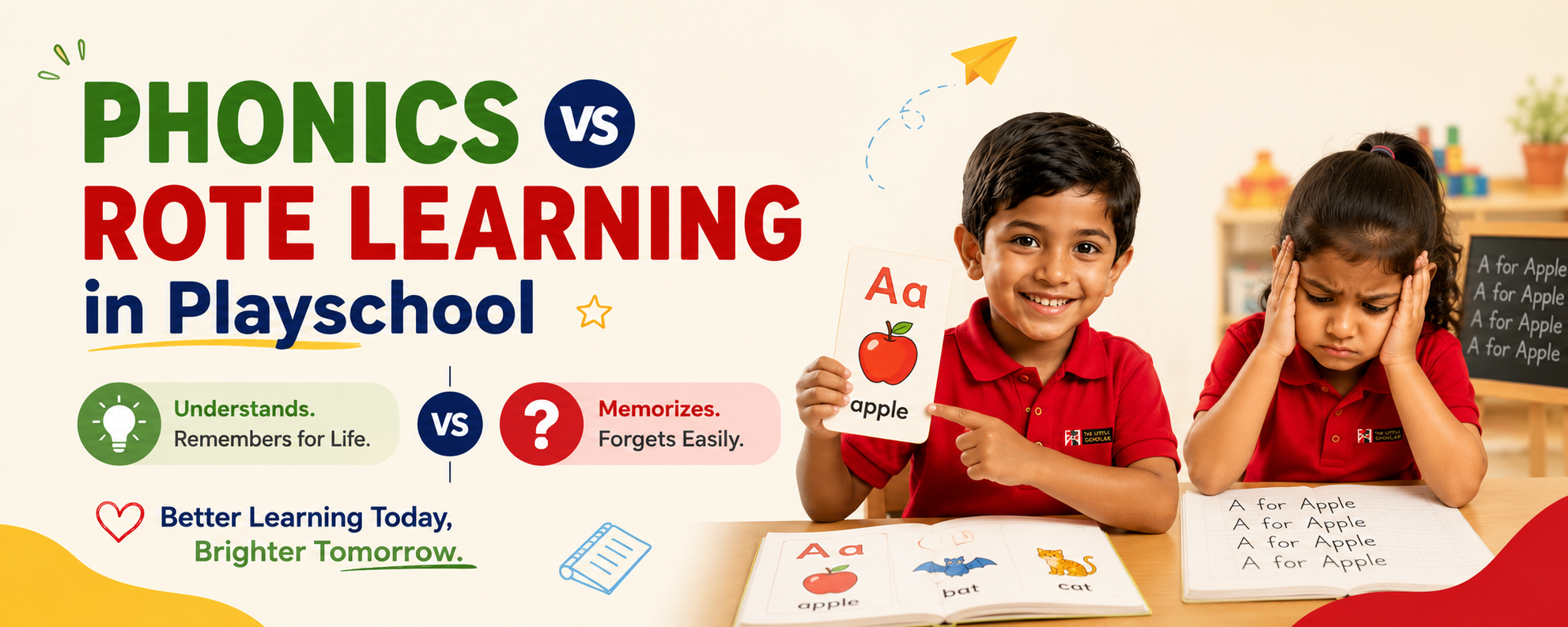
Phonics vs. Rote Learning: Why Phonics Builds Confident Readers
A child who memorises a hundred words and a child who understands how letters work are not the same kind of reader. Here is why the difference matters, and why the best play schools in Ghaziabad are choosing phonics over memorisation.
Most parents of young children have experienced this moment. Their three or four-year-old can recite the alphabet smoothly. They can spell their name. They might even read out a few words from a flashcard. And the parent thinks, brilliantly, that their child is reading. Then they hand the child a new book, with new words on it, and the reading stops. Suddenly the child cannot work out what is on the page in front of them.
That moment is a real one, and it is genuinely revealing. What it shows is the difference between a child who has memorised some words and a child who actually understands how reading works. For parents looking for the best play school in Ghaziabad, this distinction matters more than almost any other early academic question. Because the schools that teach phonics well produce children who can read unfamiliar words confidently. And the schools that rely on memorisation produce children who can only read what they have already seen before.
The Question Every Parent Eventually Asks
Should my child learn through phonics or rote memorisation? Most parents do not phrase it this way, but it is the question sitting underneath a lot of what they are trying to work out about their child’s early education. Should the focus be on remembering words, or on understanding how letters and sounds connect?
This is not a small choice. The reading approach a child experiences in their preschool years shapes how they relate to books, how confidently they handle unfamiliar text, how well their spelling develops, and even how comfortable they feel speaking up in school. It also shapes whether reading becomes a joy or a chore, which is arguably the more important question.
The good news is that research has settled this question pretty clearly. Phonics, when taught well, produces stronger and more confident readers than rote memorisation alone.
What Rote Learning Actually Is
Rote learning is when a child memorises information by repeating it, without necessarily understanding the underlying logic. In the context of reading, this looks like a child memorising the shapes of the letters, the names of the letters, and a list of whole words they have seen many times. The child can repeat what they have memorised, but they have not been taught the rules that connect letters to sounds.
This is not entirely useless. Repetition has its place, and there are some things that genuinely need to be memorised. The problem is when memorisation becomes the only strategy a child has. When they meet a word they have not seen before, they have no tools to figure it out. They have to wait for an adult to tell them what it says. Over time, this experience teaches them that reading is something that happens to them, not something they do.
A child who has only learned to memorise will always be limited to the words they have already seen. A child who has learned phonics can read words they have never encountered before, because they have the tools to work them out. That difference compounds enormously over the years that follow.
What Phonics Actually Is
Phonics is the teaching approach that focuses on the relationship between letters and the sounds they make. Instead of memorising whole words, children learn that the letter “s” makes a particular sound, the letter “a” makes a particular sound, and the letter “t” makes a particular sound. They then learn how to blend those sounds together to form the word “sat”.
Once a child understands this principle, something powerful happens. Every new word becomes a puzzle they have the tools to solve. They can look at “mat”, “rat”, or “bat” and work them out, because the underlying logic is the same. They are no longer dependent on memory alone. They have a system.
This is also how reading actually works in English. The language is built from letter-sound relationships, and a child who understands those relationships has access to thousands of words, not just the ones they have memorised. Phonics gives them the key to the whole system.
Phonics vs. Rote: A Side-by-Side Look
The clearest way to see the difference between these two approaches is to look at the question each one is asking the child.
Rote Learning
Memorise the word
The child sees the whole word and tries to recall whether they have seen it before. If they have, they can read it. If they have not, they cannot.
“Can you remember this word?”
Phonics
Work the word out
The child breaks the word into its individual sounds, blends those sounds together, and reads the word, whether they have seen it before or not.
“Can you work this word out?”
Both approaches involve effort, but the kind of effort is fundamentally different. Memorisation asks the child to recall. Phonics asks the child to reason. And reasoning, once developed, applies to every new word a child will encounter for the rest of their reading life. That is why phonics produces independent readers and rote memorisation, on its own, often does not.
Why Phonics Builds Stronger Readers
The research on phonics is some of the most robust in early childhood education. Decades of studies across multiple countries have consistently shown that systematic phonics instruction produces measurably better outcomes than memorisation-based approaches across several dimensions.
Stronger Reading Fluency
Children read more smoothly, with fewer pauses, because they have the tools to handle unfamiliar words without freezing.
Better Spelling
Understanding letter sounds makes spelling far easier. Children spell phonetically, then refine as they encounter spelling patterns.
Clearer Pronunciation
Identifying individual sounds in words sharpens speech clarity and gives children better control over how they pronounce new words.
Wider Vocabulary
Children who can decode unfamiliar words encounter more new vocabulary in their reading, and vocabulary grows steadily as a result.
Real Comprehension
Decoding becomes automatic with phonics, freeing up mental space for understanding the meaning of what is being read.
Genuine Confidence
The experience of working out a new word independently builds a kind of confidence that no memorised reading can produce.
Children taught with phonics become active problem solvers when they read. They look at a word they do not recognise and lean in rather than freeze. That mindset, that posture of “I can work this out”, is one of the most valuable things a child can take from their early years into the rest of their education.
What Phonics Does Beyond Reading
It would be reasonable to assume that phonics is purely about reading. But the benefits ripple out far more widely than that. Children who learn phonics tend to develop sharper listening skills, because they are trained to pay attention to the sounds within words. Their speech becomes clearer because they are conscious of individual sounds. Their spelling improves naturally because they understand the relationship between what they hear and what they write. Their handwriting often improves too, because tracing and forming letters becomes meaningful rather than just visual.
Perhaps most importantly, children who learn phonics begin to notice patterns in language. They spot rhymes, they recognise word families, they start to make connections between words that look or sound similar. This kind of pattern recognition is one of the most powerful forms of thinking a young child can develop, and it carries forward into mathematics, science, and every other area of learning.
How to Make Phonics Genuinely Fun
Here is where many parents get nervous. The word “phonics” sounds clinical and academic, and there is a worry that introducing it too early will turn reading into a chore. The good news is that this is entirely a matter of how phonics is taught, not whether it is taught.
Done well, phonics is one of the most enjoyable parts of preschool. Young children find sounds genuinely interesting. They love finding the “s” sound in their friends’ names, or the “m” sound in “mango”. They like games that involve listening carefully, songs that play with rhyme, and stories that emphasise sound patterns.
-
Stories and Read-Alouds
Reading stories where certain sounds are repeated naturally trains the ear without ever feeling like a lesson. Children begin to notice patterns on their own.
-
Songs and Action Rhymes
Music and rhythm cement letter sounds in memory in a way that pure repetition never can. A child who has sung a phonics song will remember the sound for years.
-
Sound Hunts
Looking around the room for things that start with a particular sound turns the whole classroom into a learning environment, and children love the search.
-
Sensory Activities
Tracing letters in sand, building words with magnetic letters, manipulating wooden alphabet blocks. Multi-sensory engagement makes sounds stick deeper.
-
Puppet Play and Role Play
Puppets who can only say words starting with a particular sound, or shopkeepers who only sell things beginning with “b”. Imaginative play teaches phonics painlessly.
-
Art, Music, and Movement
Tracing letters with paint, doing actions that match the shape of a letter, dancing to phonics songs. The body learns alongside the mind.
The principle behind all of these is the same. Phonics is not a worksheet activity. It is a way of paying attention to the sounds inside language, and that attention can be built through almost any enjoyable, hands-on experience.
How The Little Scholar Playschool Teaches Phonics
At The Little Scholar Playschool in Kavi Nagar, Ghaziabad, phonics is not a separate class. It is woven into how language is approached throughout every day.
The curriculum introduces one sound at a time, building up gradually so children have time to absorb each new piece before moving on. Each sound is introduced through multiple senses: children listen to it, say it, sing about it, trace it, find it in objects around the classroom, and use it in the words they read and the stories they hear. By the time a new sound is fully introduced, children have experienced it in five or six different ways, which is exactly how children of this age learn best.
Storytelling, guided reading, dramatic play, and classroom conversations all reinforce phonics throughout the day. Children are never asked to memorise long lists of spellings without understanding the sounds behind them. The approach is patient, gradual, and consistently joyful, because reading at this age should feel like an adventure rather than an assignment.
Teachers at The Little Scholar are trained to encourage curiosity rather than rewarding only correct answers. When a child tries to read a word and gets it slightly wrong, the response is to help them work through the sounds rather than just correct them. This approach builds independent readers who lean into difficulty rather than waiting to be rescued from it.
Parents looking for the best play school in Ghaziabad for genuine literacy development often mention this combination of academic rigour and emotional warmth as one of the reasons they chose the school. Read what families across Ghaziabad say on their Google Business profile.
What Parents Can Do at Home
The most powerful reading environment for a child is not at school. It is at home. The number of words a child hears at home, the number of stories that get read to them, the quality of the conversations they have, all matter enormously for reading development. None of this requires special materials or formal teaching. It requires attention.
Simple ways to support phonics at home
The most important principle is to keep reading joyful. The moment reading time becomes a source of stress, anxiety, or correction, children begin to associate it with discomfort. The children who become lifelong readers are usually the ones whose earliest memories of books are about cuddling up with a parent and being delighted, not about being tested.
The single best thing any parent can do for their child’s reading is to model the love of reading themselves. A child who sees a parent enjoying a book learns that reading is something adults willingly choose. That single observation, repeated over years, is more powerful than any phonics programme.
Looking for a Preschool That Teaches Reading the Right Way?
If you want a preschool where your child builds a genuine, joyful relationship with reading through phonics and storytelling, the team at The Little Scholar Playschool Kavi Nagar is happy to help. The admission inquiry form takes just a couple of minutes.
Frequently Asked Questions
What is the difference between phonics and rote learning?
Phonics teaches children the relationship between letters and the sounds they make, giving them the tools to decode any word they encounter. Rote learning depends mainly on memorising whole words and spellings, which limits children to reading only the words they have seen before. The best play schools in Ghaziabad use phonics as their primary approach because it produces independent, confident readers.
Why is phonics important in preschool?
Phonics builds the foundation for early reading, spelling, and language development while developing genuine confidence. Children who learn phonics early can read unfamiliar words, spell more accurately, speak more clearly, and approach books with curiosity rather than anxiety. These benefits compound throughout their school years and beyond.
Does The Little Scholar Playschool teach phonics?
Yes. Phonics is integrated throughout the activity-based language curriculum at The Little Scholar Playschool in Kavi Nagar, Ghaziabad. Children learn one sound at a time through multisensory experiences including stories, songs, sensory play, puppet play, and guided reading. The approach is joyful, patient, and built into how every day runs.
Can phonics and memorisation be used together?
Yes. Understanding through phonics comes first, and meaningful repetition can reinforce learning once children grasp the underlying principles. The problem is not memorisation itself. It is relying on memorisation alone without giving children the decoding skills that allow them to handle new words independently.
How can parents practise phonics at home?
The most effective things parents can do are reading aloud daily, playing simple sound games during everyday routines, singing rhymes together, pointing out letters and sounds during ordinary activities, and celebrating effort rather than perfection. The most important principle is keeping reading joyful so children associate books with comfort and delight.
What makes The Little Scholar the best play school in Kavi Nagar Ghaziabad for phonics?
The Little Scholar combines a structured phonics curriculum with a joyful, multisensory approach to language. Children learn through stories, songs, sensory play, and guided reading rather than worksheets or rote drilling. Teachers are trained to build curiosity and confidence rather than just correct mistakes. You can read parent reviews on their Google Business profile.
Reading as a Lifelong Gift
The goal of teaching a child to read is not actually to teach them to read. It is to help them love reading. A child who reads fluently but reluctantly will not become an adult who reads. A child who reads with joy, even if their progress is slower in the early years, will carry books into every part of their life.
Phonics, taught well, is one of the most reliable paths to that kind of reading life. It gives children the tools they need to handle any text they encounter, while also giving them the experience of working things out for themselves, which is itself a source of confidence and pride. Combined with an environment where reading is warm, playful, and consistently joyful, phonics produces children who do not just know how to read. They want to.
For families in Ghaziabad looking for the preschool that gets this combination right, the conversation is worth having. The reading foundation a child builds in their early years stays with them. It is one of the most lasting gifts an education can give.