
Character · Values Education · Best Play School in Ghaziabad
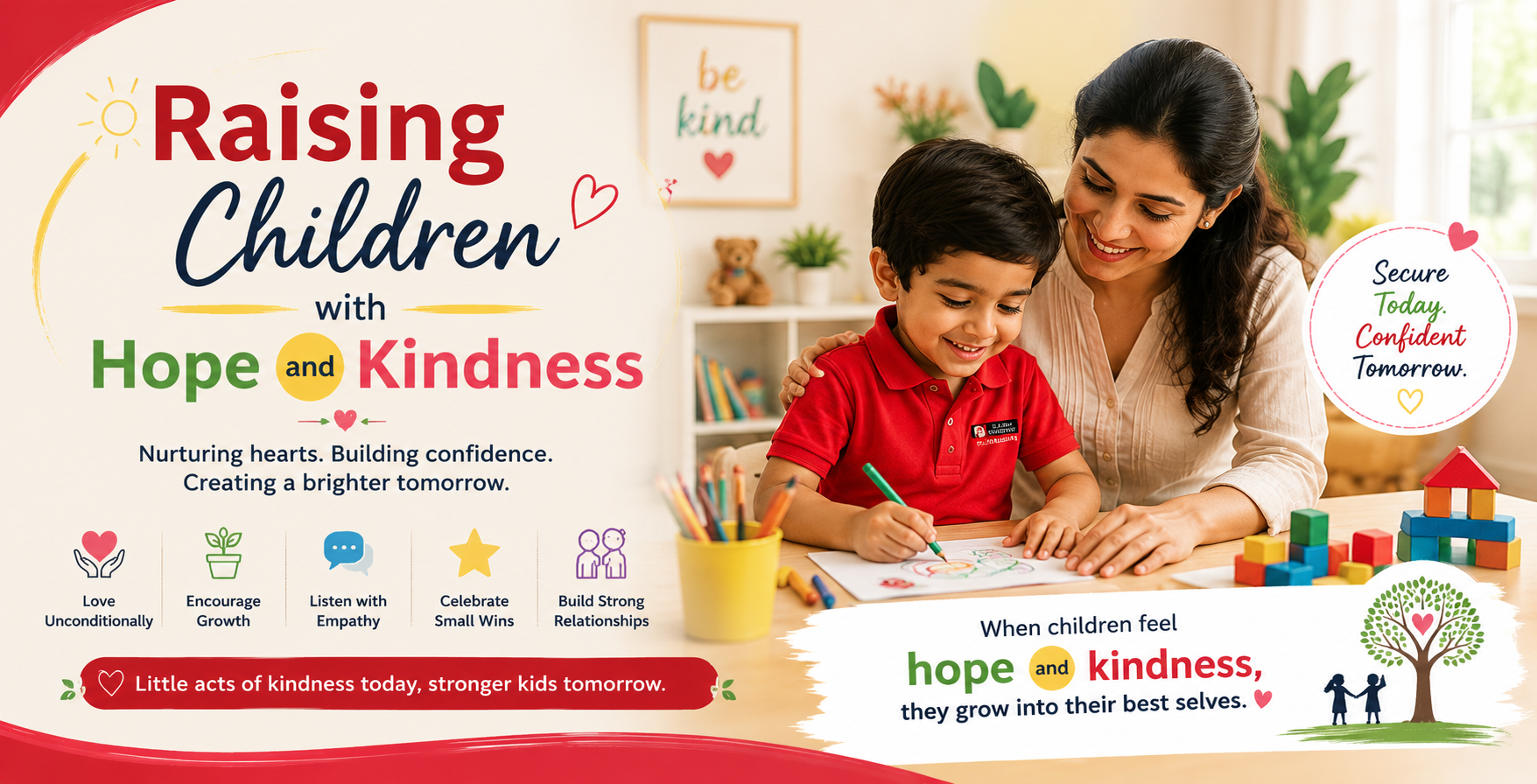
Raising Children Who Choose Hope, Kindness, and Courage
Nobody knows exactly what world our children will grow up into. What we do know is that the qualities that will help them thrive in it, hope, kindness, courage, and the belief that problems have solutions, are built now, in the earliest years of life. Here is how families and schools can raise those children on purpose.
Education should not merely prepare children to earn a living. It should prepare them to live a meaningful life.
As parents and educators, we often wonder what kind of world our children will grow up in. Will it be more competitive than the one we knew? Will technology change everything faster than we can keep up with? Will academic pressure only intensify?
The World Our Children Will Inherit
The honest truth is that we cannot control most of what our children will face. We cannot predict the economy, the technology, the specific challenges of their generation. What we can do, and what genuinely matters, is equip them with the values, emotional strength, and mindset to face whatever comes with confidence.
The most successful adults are almost never the ones who never faced difficulties. They are the ones who learned to adapt, seek help, find creative solutions, and keep going without losing hope. Those qualities are not something a person discovers in their twenties. They are built in childhood, quietly, through the small daily interactions between children and the adults who raise them.
Parents searching for the best play school in Ghaziabad are increasingly aware of this. They want schools that take character seriously. They want an education that prepares their child to become a good human being, not just a good student. This article is about how that actually happens.
Raising Solution Seekers, Not Problem Thinkers
Every child encounters challenges. A disagreement with a friend. Not being picked for a competition. Struggling with an activity that came easily to a classmate. Feeling nervous before speaking in front of others. These moments are not obstacles to childhood. They are childhood.
What matters is how adults respond, because that response teaches the child how to think. When a child comes home upset and says, “nobody wants to play with me,” the instinct is to comfort and reassure. But the more powerful response is to gently guide them toward their own thinking.
- What do you think you could do?
- Would you like to invite someone to play tomorrow?
- How could we make tomorrow different?
- Who could help you with this?
These questions might feel awkward the first few times. But they do something important. They tell the child, without saying so directly, that they are capable of thinking through the situation themselves. Over time, they begin to believe that every problem has possible solutions, and that they are the kind of person who can find them.
- Critical thinking
- Emotional regulation
- Confidence
- Creativity
- Decision-making
- Independence
Children who grow up believing “I can find a way” are far more resilient than children who believe “someone else will solve everything for me.” This one internal belief, formed in the earliest years, shapes how a person approaches every challenge for the rest of their life.
The same principle applies to praise. When a child builds a tower and it keeps falling, the temptation is to step in and fix it. Try instead, “I noticed you did not give up. What else could you try?” When a child loses a race, resist the urge to make the result the whole conversation. Ask what they enjoyed. Ask what they learned. Ask how it felt to cheer for their friends. These small conversational shifts teach children that growth matters more than trophies, and effort matters more than outcomes.
Making Every Child Feel Safe, Loved, and Valued Beyond Their Results
One of the greatest gifts an adult can give a child is unconditional acceptance. Not conditional on marks. Not conditional on behaviour. Not conditional on how the child compares to their cousin, their classmate, or their older sibling. Just genuine, uncomplicated acceptance of who they are.
Unfortunately, many children gradually begin to absorb a different message. That love, praise, and pride are things they earn through performance. That mistakes disappoint. That falling short means letting people down. This belief creates a specific kind of fear, and fear is rarely the environment where children learn well.
A Fear-Based Belief
“If I perform well, people are proud of me. If I fail, I disappoint everyone.”
A Safety-Based Belief
“I am loved even when I make mistakes. My family believes in me no matter what.”
Children who feel genuinely safe emotionally become confident learners because they know failure is not permanent. Their identity does not collapse when a single thing goes wrong. This kind of safety is not built through one big conversation. It is built through hundreds of small moments across years.
At Home, This Looks Like
- Parents listen without interrupting
- Mistakes become learning opportunities
- Feelings get acknowledged, not dismissed
- Conversations happen without fear of being scolded
- Difficult topics are safe to bring up
At School, This Looks Like
- Every child is greeted warmly by name
- Questions are welcomed, not tolerated
- Children are never humiliated for mistakes
- Every achievement, big or small, is noticed
- Teachers know each child individually
The words we say most often to children shape how they come to understand themselves. Some phrases are worth repeating deliberately, in different moments and different tones, until they become part of the child’s inner voice.
- I believe in you.
- You don’t have to be perfect.
- We’ll figure this out together.
- Thank you for trying.
- I love you no matter what.
Simple words. Lifelong impact. The child who has heard these things repeatedly is the child who, twenty years later in a moment of self-doubt, will still hear them somewhere inside themselves.
The True Aim of Education Is to Build Better Human Beings
If education teaches children only to score marks, it has achieved only a fraction of what education is meant to do. The real purpose is much larger. Education should help children become the kind of people the world genuinely needs more of.
The world does not just need more intelligent people. It needs more kind people. A child who comforts a crying classmate. A student who speaks up when they see someone being treated unfairly. A young adult who chooses integrity when a shortcut is available. These are the real outcomes of education, and they matter more, in the long run, than any exam result ever will.
Character is not built through one annual assembly on values. It is built through daily habits. Helping to tidy up the classroom. Waiting patiently for a turn. Saying thank you and meaning it. Respecting a classmate who is different in some way. Taking responsibility after making a mistake, rather than blaming someone else. Celebrating another child’s success without envy. These ordinary moments quietly shape extraordinary character over years.
Teaching That Humanity Is One Family
One of the most beautiful things about young children is how naturally accepting they are. They do not judge each other based on religion, language, financial background, or family type. Those biases come later, and they are almost always learned from the adults around them.
Preschool is a beautiful opportunity to nurture a broader worldview before those learned biases have a chance to take root. Children can learn, and easily believe, some genuinely important truths.
Every family is unique. Every culture deserves respect. Every language is beautiful. Every profession contributes to society. Every person deserves kindness. When children grow up truly believing these things, they become more inclusive, more compassionate, and more socially responsible adults than any generation before them.
None of this requires a special programme. It requires classroom practices that consistently expose children to diversity in warm, ordinary ways.
Small practices that quietly build global citizens
These experiences do not teach children to tolerate difference. They teach them to appreciate it. That is a genuinely different, and more powerful, lesson to grow up with.
Children Learn From What Adults Do, Not What They Say
Every parent has caught themselves telling a child, “speak politely” while speaking sharply to someone else in the same conversation. This is not a criticism. It is just how families work. But children are watching more than they are listening, and it matters.
If parents speak respectfully to domestic staff, children absorb what respect looks like. If teachers apologise sincerely after making a mistake, children learn that apologising is a normal, healthy thing that strong people do. If grandparents show patience and warmth, children internalise those as qualities of a good life. If adults help strangers without expecting anything in return, children come to believe that helping others is simply what people do.
Children imitate before they understand. They learn values by watching them lived, not by being told about them. This is why the greatest teachers of values are not schools or textbooks. They are the adults in a child’s life, going about their ordinary days.
The strongest learning happens when parents and teachers reinforce the same principles across the two most important environments in a child’s life.
This kind of consistency gives children a genuinely clear understanding of what values look like in practice, across every space they live in. When home and school send the same message, that message becomes something the child can rely on. It stops being a rule they have to remember and becomes a part of who they are.
Let’s Celebrate Kindness as Much as Achievement
Imagine a school assembly where children are recognised not only for the highest marks or best sports performance but also for qualities that shape who they will become as adults.
These awards send a genuinely powerful message. Who children become matters more than what they score. And when children realise that kindness is celebrated with the same energy as academic achievement, they naturally begin practising it more. Recognition shapes behaviour. Children repeat what adults appreciate, and stop bothering with what adults ignore.
A Reflection for Parents Tonight
Here is a small experiment worth trying tonight, before your child falls asleep. Change one question. Just one.
Change the question you ask tonight
“What marks did you get?”
“What made you smile today?”
“Whom did you help today?”
“What new thing did you learn about yourself today?”
These questions may seem small in the moment. But over years, they teach children that life is measured not only by achievements, but by relationships, kindness, growth, and hope. They shift the child’s daily reflection from “did I perform well enough today?” to “did I live well today?” That shift, when it becomes habitual, changes everything.
Your child may forget the marks they scored in Class 3 or the prize they won in a school competition. But they will always remember how the people around them made them feel. They will remember whether they were seen as a person or as a performance. That may be the greatest education of all.
How The Little Scholar Playschool Ghaziabad Builds This In
At The Little Scholar Playschool in Kavi Nagar, Ghaziabad, every idea in this article is not aspiration. It is practice. The classroom is designed around the principle that character grows through daily habits, and that every ordinary moment of a school day is an opportunity to help children become the kind of people the world needs.
Teachers here use solution-focused questions with children rather than jumping in to solve every problem. They celebrate effort as consistently as they celebrate outcomes. They greet every child warmly by name, welcome questions, and treat mistakes as opportunities for genuine learning rather than moments for correction. Kindness gets noticed and named as often as any academic achievement, because the school understands that children repeat what gets recognised.
Cultural diversity is built into daily classroom life. Different festivals get celebrated. Different stories get read. Different foods get appreciated. Children absorb, from the inside, that humanity is genuinely one family, and this becomes something they carry with them into every environment they will move through for the rest of their lives.
Parents searching for the best play school in Ghaziabad often mention this integrated approach to character and academics as one of the main reasons they choose The Little Scholar. Read what Ghaziabad families say on their Google Business profile.
Preparing Children for Life, Not Just School
If you want a preschool where your child will be seen, respected, and gently guided to become their strongest and kindest self, the team at The Little Scholar Playschool Kavi Nagar would love to welcome your family. Book a school visit or fill the admission inquiry form.
Frequently Asked Questions
How can I teach my child to solve problems instead of getting upset?
Resist the urge to immediately solve every problem for them. Ask questions like, “what do you think we could do?” or “can you think of another way?” or “who could help us?” These conversations encourage critical thinking, confidence, and resilience while teaching children that most challenges can be worked through with patience and creativity. Over time, this becomes their default way of thinking.
What should I do if my child is afraid of failing?
Help your child understand that failure is a part of learning, not the end of the story. Share stories of people who experienced setbacks before achieving success. Praise effort, perseverance, and improvement rather than focusing only on results. Children who know they are loved regardless of their performance become far more willing to try new things without fear of judgment.
How can schools reduce academic pressure on children?
Schools can create healthier learning environments by celebrating individual progress, encouraging curiosity, reducing unhealthy comparisons, and recognising qualities like kindness, teamwork, creativity, and resilience alongside academic achievement. Every child should feel valued for who they are, not only for the marks they score. The best play schools in Ghaziabad build this into their everyday culture.
Why is emotional safety important in a classroom?
Children learn best when they feel emotionally secure. A classroom where children know they can ask questions, make mistakes, express their feelings, and seek help without fear of embarrassment encourages confidence, creativity, and a lifelong love for learning. Without emotional safety, children tend to hold back, which limits both learning and personal growth.
How can parents help children develop genuine confidence?
Confidence grows through small daily successes. Encourage your child to make simple decisions, complete age-appropriate tasks independently, solve minor problems, and celebrate their honest efforts. Instead of “you’re the best,” try “I’m proud of how hard you worked.” This builds real self-belief rather than dependence on external praise, and it holds up when things get difficult.
Should children be rewarded only for academic achievements?
No. Academic success matters, but qualities like honesty, kindness, responsibility, teamwork, perseverance, gratitude, and empathy are equally valuable. Recognising these behaviours helps children understand that good character is just as important as good grades. Children come to believe about themselves whatever adults consistently name and celebrate.
How do I teach my preschooler kindness?
Children learn kindness by watching the adults around them. Show kindness in your daily interactions, encourage your child to help others, appreciate thoughtful behaviour when you see it, read stories about compassion, and involve them in simple acts of generosity. Kindness grows through consistent practice and modelling, not through occasional lectures about being nice.
Why should children learn to respect all professions?
Every profession contributes to society in meaningful ways. Teaching children to genuinely value teachers, artists, doctors, engineers, farmers, sanitation workers, carpenters, chefs, designers, and countless others helps them develop humility, gratitude, and respect for the dignity of every person’s work. Children who grow up with this understanding become adults who treat everyone well.
What values should every preschool child learn?
The most important values to nurture in early childhood include kindness, honesty, gratitude, respect, responsibility, empathy, patience, cooperation, courage, and perseverance. These values provide a strong foundation for success in school, in relationships, and in life. The best play schools in Ghaziabad build them into daily routines rather than treating them as a separate subject.
How can parents and teachers work together to support children?
Children thrive when they receive consistent guidance at home and at school. Regular communication between parents and teachers, shared expectations, positive reinforcement, and a common focus on emotional wellbeing helps children feel secure and supported as they grow. When home and school send the same message, children stop having to guess which set of rules applies where.
Why is character education as important as academic education?
Academic knowledge helps children build careers, but character helps them build meaningful lives. Honesty, empathy, resilience, respect, and integrity influence how children treat others, respond to challenges, and eventually contribute to the world. The strongest education nurtures both the mind and the heart, not one at the cost of the other.
What is the ultimate purpose of education?
The purpose of education extends far beyond examinations and report cards. True education helps children become curious learners, compassionate friends, responsible citizens, thoughtful leaders, and individuals who use their knowledge to improve the lives of others. When children grow into kind, confident, ethical adults, education has fulfilled its real purpose.
How can I start meaningful conversations with my child every day?
Instead of the usual “how was school?”, try questions like “what made you smile today?”, “did you help someone today?”, “did someone help you today?”, “what was the most interesting thing you learned?”, “what was difficult, and how did you handle it?”, or “what are you proud of today?” These questions encourage reflection, emotional awareness, and a much stronger parent-child connection over time.
How does The Little Scholar Playschool prepare children for life, not just school?
At The Little Scholar Playschool in Kavi Nagar, Ghaziabad, every child deserves to feel safe, respected, and inspired. The approach combines academic readiness with social-emotional learning, creativity, value-based education, life skills, and joyful experiences that help children grow into confident, compassionate, and resilient individuals. Success is measured not only by what children know but by the values they carry throughout their lives. Read parent reviews on their Google Business profile.
Raising Hopeful Children in an Uncertain World
Every generation of parents has faced its own set of worries. Our parents worried about opportunities. Today’s parents worry about pressure, technology, mental health, and a world that sometimes feels more competitive than kind. Those worries are legitimate. But there is one timeless truth worth holding onto.
Children who know they are loved. Children who believe they matter. Children who learn to solve problems rather than run from them. Children who care about the people around them. Children who value themselves beyond marks and outcomes. These children are far more likely to face whatever the future brings with courage and hope than any generation before them.
That is the kind of childhood every child deserves. And it is the shared responsibility of every family, every school, and every community in Ghaziabad to help make it possible.
Children may forget the lessons we teach, but they will always remember how we made them feel. When we raise children who are kind, resilient, hopeful, and compassionate, we are not just preparing them for school. We are preparing them to change the world.