Festivals & Learning · Early Childhood · Best Play School in Ghaziabad
More Than a Celebration: How Festivals Help Children Learn, Grow, and Connect
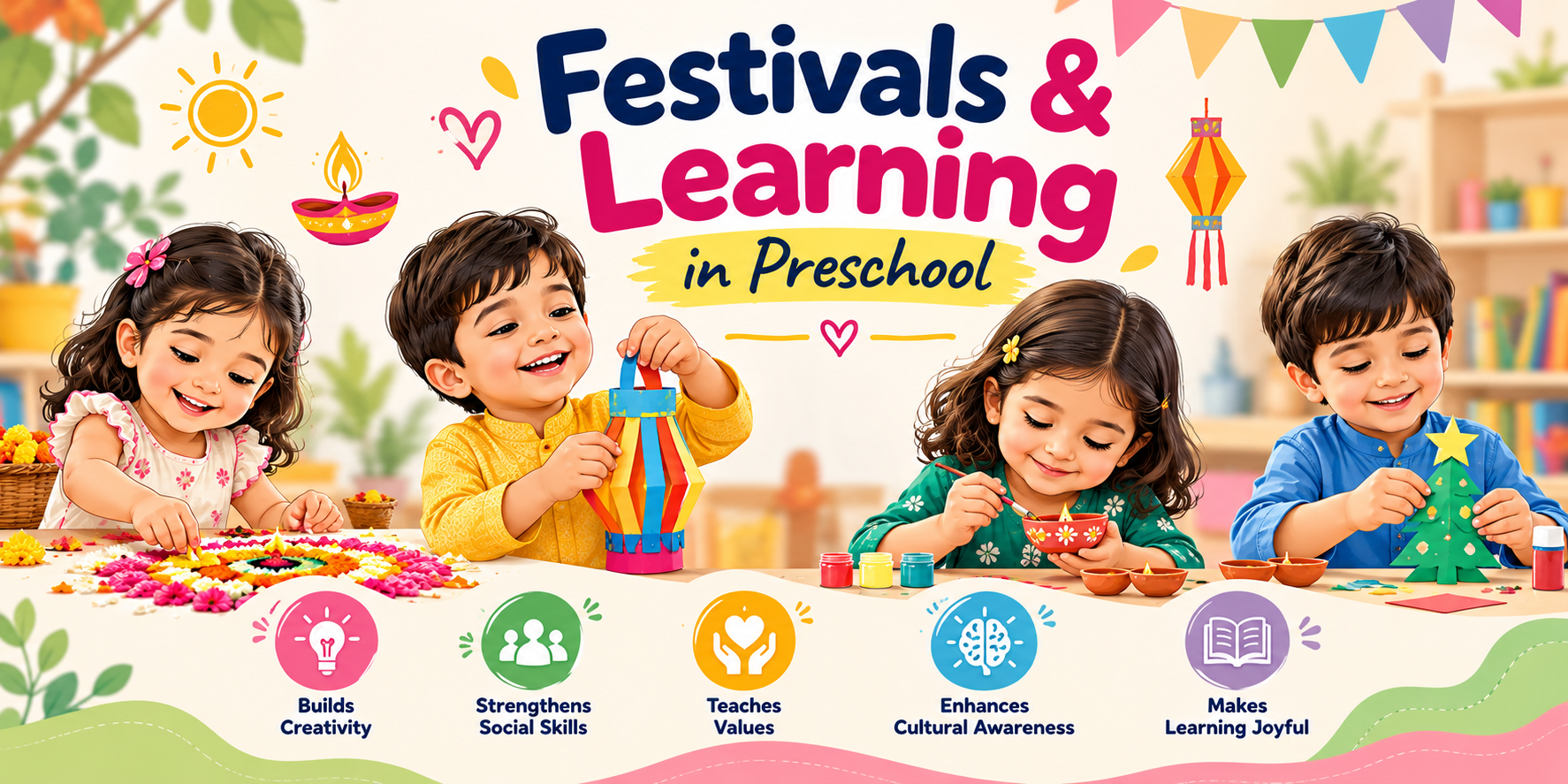
To an adult, a preschool festival craft can look like just another craft. Look a little closer, and you will see something extraordinary happening inside it. Story, choice, colour, memory, fine motor control, courage, and connection, all folded into a slightly uneven paper diya. Here is why festivals may be one of the most powerful learning tools a preschool has.
Ma’am, look! I made this for Mumma!
A little girl stands proudly in the middle of her preschool classroom, holding a slightly uneven paper diya in both hands. The yellow paint has spilled over the edges. There is glitter on her fingers, some on her uniform, and probably quite a lot on the classroom table. She is smiling. She is proud. And she cannot wait to take it home.
To an adult, it may look like just a child’s festival craft. But inside that little diya is so much more. There was the moment she listened to her teacher talk about Diwali. The moment she chose her colours. The concentration with which she held her brush. The decision about where to place each decoration. The little frustration when the paper tore. The encouragement from her teacher. The joy when she finally finished. And now, the excitement of sharing her creation with her mother.
That is learning. It just does not look like a conventional classroom lesson. And this is exactly what makes festivals such a wonderful part of the preschool experience. They bring the world outside into the classroom, along with stories, colours, music, traditions, food, movement, creativity, and people. When children experience festivals through age-appropriate activities, celebrations become powerful opportunities for genuine all-round development. For parents searching for the best play school in Ghaziabad, understanding what happens inside a festival classroom is one of the most useful lenses on early childhood education there is.
Young children learn best when a new idea connects with something they already know. Festivals give them that connection almost for free. They have seen a Ganesh idol at home. They have watched a family member make a rangoli. They have played with colours on Holi, sung a Christmas carol, or dressed up for Dussehra. When a preschool brings those familiar moments into the classroom, learning stops being abstract and starts feeling like an extension of the child’s own life.
When the Classroom Comes Alive
There is a specific feeling in a preschool just before a festival. The classroom begins to look different. The walls carry colourful decorations. Tables are covered with art materials. Children hear songs they may recognise from home. New stories appear at circle time. Perhaps someone has brought a diya. Perhaps there are flowers, stars, paper decorations, or colourful patterns waiting to be explored. And almost immediately, the questions start.
- Why do we light diyas?
- Why does Ganesha have an elephant’s head?
- Why do people make rangoli?
- Why do we put up a Christmas tree?
- Why do people play with colours on Holi?
- What do people do on Eid?
These questions are precious. Behind every one of them is a child trying to make sense of the world. A good preschool does not simply hand over the answer. It creates a conversation. And that conversation can go somewhere unexpected. A question about a diya may open up a discussion about light. A question about a festival may become a story. A story may become a role-play. A role-play may become an opportunity to practise language and teamwork. One small question can turn into a whole learning journey that lasts through the week.
Why Festivals Make Learning Meaningful
Preschool children are still developing their ability to hold abstract ideas. What they respond to instead is anything they can see, touch, taste, hear, or connect to their own life. Festivals are made of exactly these things. A child does not need to be taught that Diwali involves diyas. They have already seen one at home. What preschool adds is a chance to explore that familiar experience in richer, deeper, more interactive ways.
They can ask questions. They can create something with their own hands. They can listen to a story that gives context. They can compare their experience with a friend’s experience. They can discover that families in the same city celebrate the same festival in slightly different ways, and that all of those ways are beautiful. This is one of the quiet strengths of good early childhood education. It helps children connect what they are learning to everyday life, so that learning stops feeling like an event that happens only inside a classroom.
Six Festivals, Six Different Kinds of Learning
Every festival brings something different into the classroom. What looks like decoration and play from the outside is, on closer inspection, a carefully designed learning opportunity that reaches multiple areas of a young child’s development at once. Here is a closer look at six of the celebrations that shape the preschool year in India, and what each one quietly builds inside a child.
Imagine a table covered with soft clay. The children are busy pressing, rolling, and shaping it. One child makes a round head. Another attempts ears. Someone carefully tries to shape a trunk. Another child looks up and announces, quite honestly, “mine doesn’t look like Ganesha!” The teacher smiles. “That’s okay. Let’s see what you can create.” And the child tries again. That one small exchange contains almost everything early childhood education is meant to be.
The seemingly simple activity is doing quiet developmental work in the background. Children strengthen their fine motor skills through pressing and shaping. They make choices about size and design. They use their imagination. They listen to a story about Ganesha at circle time. They pick up new vocabulary. They talk to their friends about what they are creating. And most importantly, they walk away with the feeling that they can make something with their own hands.
Children are natural storytellers and enthusiastic listeners. Give them a story with interesting characters and their attention holds almost automatically. Dussehra provides a beautiful opportunity to introduce age-appropriate stories and conversations around themes like courage, kindness, responsibility, and making good choices. A teacher might pause during the story and ask, “what do you think will happen next?” or “how do you think the character feels?” or “what would you have done?” or “was that a kind choice?”
No complicated explanations required. The child is simply thinking about a character’s actions and feelings, which is exactly how empathy first develops. Later, the children might recreate parts of the story through puppets or simple role-play. One child becomes a character. Another becomes the narrator. Someone else makes a prop. A traditional story becomes an opportunity to develop language, imagination, memory, emotional understanding, and confidence. And when a shy child stands up and says their first line in front of the group, something else quietly happens. They discover their voice.
The classroom fills with colour. Children decorate paper diyas, create rangoli patterns, and make simple festive decorations. Look closely at what is actually happening. A child painting a diya is practising hand control. A child arranging shapes into a rangoli is discovering patterns. A child counting decorative pieces is doing early numeracy without realising it. A group creating one large classroom decoration is learning to cooperate. A child explaining her artwork to a teacher is developing communication skills.
Rangoli is especially rich for young children because it naturally combines art and early mathematical thinking. A teacher might begin with a simple pattern. Circle. Flower. Then a repeated sequence of colours. Red, yellow, red, yellow. “What should come next?” Children begin to recognise patterns, compare shapes, count, and explore symmetry. And they do all of this while thinking they are simply making something beautiful. That is the quiet magic of learning through play. Children do not need to know the name of the concept for the experience to be meaningful.
During Eid, the classroom becomes a place for children to explore ideas of family, kindness, gratitude, and sharing. Perhaps the children create greeting cards. Maybe they listen to a simple story. They might talk about special foods families enjoy on the day. The teacher may ask gentle open questions. “What do you like sharing with your friends?” “How does it feel when someone shares with you?” “Who would you like to make a card for?” The answers can be wonderfully honest. My best friend. Mumma. My Dadu. My sister.
The activity gently shifts from being about learning facts about a festival to being about understanding the emotions that make celebrations meaningful in the first place. Children begin to discover that celebrations can be about making other people happy too, not only about receiving. That is a genuinely important early lesson in the emotional intelligence that will shape their relationships for the rest of their lives.
The classroom changes again. Stars appear on the walls. A Christmas tree goes up. Children hear bells and familiar songs. Some are already singing along. Others are watching carefully. A few are simply fascinated by the decorations. Christmas gives preschools an opportunity to bring together storytelling, music, craft, role-play, and gentle conversations about kindness and generosity. Children might make paper stars. They might create cards for their parents. They might learn a simple carol. They might participate in a small class performance.
But perhaps the most beautiful moment comes when a child hands their handmade card to a parent. It may be a simple piece of paper with uneven letters and a few colourful shapes. To the parent, it can be a treasure kept for years. And the child learns something too. “Something I create can bring happiness to someone I love.” That realisation is one of the earliest experiences of the joy of giving, and it stays.
Then comes Holi, and suddenly the classroom is full of colour. Beyond the excitement, Holi offers wonderful opportunities for exploration and observation. Children can experiment with colours through art activities. “What happens when blue and yellow meet?” “Can you make a new colour?” “Which colour do you like best?” They are exploring cause and effect without ever using those words. They are observing change. They are making choices. They are expressing preferences.
Music and movement can be added to the experience, allowing children to dance, clap, and participate physically. Teachers can also introduce gentle ideas around respecting others during celebrations. Not everyone wants to participate in the same activity in the same way, and that is completely okay. Even a joyfully colourful festival becomes an opportunity to develop creativity, observation, movement, and quiet social awareness at the same time.
The Hidden Learning Inside Every Festival Activity
The most valuable part of festival learning is what a child cannot see happening. To their eyes, they are just having fun. To the adults watching carefully, layers of development are happening at once, in every activity. Here is what an outside observer might notice.
- A child paints a diya → Hand control & focused attention
- A child arranges rangoli shapes → Pattern recognition & symmetry
- A child counts decoration pieces → Early numeracy
- A child retells a festival story → Language sequencing & memory
- A child sings a Christmas carol → Rhythm, memory, listening
- A child makes a card for Mumma → Empathy & social bonding
- A child works on a group decoration → Cooperation & negotiation
- A child performs on stage → Confidence & self-expression
Every festival activity in a well-designed preschool is doing at least three or four different kinds of developmental work at the same time. The children are simply having fun. The teachers know exactly what is being built underneath.
Festival Stories Help Children Find Their Voice
There is something quietly powerful about storytelling in the early years. A child who barely speaks during ordinary classroom conversations can become completely absorbed in a festival story. Suddenly, they have an opinion. “Why did he do that?” “I think she should help him.” “I know what happens next!” Stories give children something meaningful to talk about, and that is often what unlocks their willingness to speak up in the first place.
Stories also help children build vocabulary and practise putting thoughts into words. When teachers gently encourage them to retell a story, children practise sequencing. First this happened. Then this happened. And finally. Their version may not be perfectly ordered, and it does not need to be. They are learning to organise their thoughts and communicate them to another person, which is one of the most important skills any human being ever develops.
Music and Movement Make Learning Memorable
Ask a child what they remember from a festival celebration and they may not tell you what they learned. They may just start singing the song. They may demonstrate the dance. They may remember the actions. This is because movement and music engage children in a completely different way from passive listening.
What festival music and movement quietly build
Whether it is a Christmas carol, a Diwali song, a Holi dance, or a simple movement activity connected to another festival, music offers children another way to express themselves. And often, they have no idea how much they are learning while they are doing it. That is exactly how the best learning happens at this age.
The Festival Stage: A Small Moment of Courage
There is a particular kind of nervous excitement in a preschool festival performance. Parents sit waiting with their phones ready. The children stand in their costumes, some fidgeting, some frozen. One child waves at Mumma. Another forgets the first line entirely. Someone starts dancing before the music begins. Everyone smiles anyway. Somehow, the performance comes together. And when the children finish, they hear applause.
What a small child actually achieves in a festival performance
- They stood in front of people, which many adults still find hard
- They tried something completely unfamiliar
- They remembered something they had learned
- They managed their nervousness enough to keep going
- They completed it, whether or not it went perfectly
- They heard applause and felt seen for it
For adults, a festival performance is a few minutes of watching. For a child, it can be one of the biggest moments of their preschool year. The objective is never perfection. It is participation. And the child who has stood on a stage once, with all the small courage that took, carries a slightly bigger version of themselves back to class the next day.
Working Together to Create Something Special
Festival celebrations also create natural opportunities for children to work together as a group. Imagine a classroom preparing one large Diwali decoration for the school hall. One child wants to paint the flowers. Another wants to add glitter. Someone else wants to place the diyas. The teacher has to guide them through the inevitable small disagreements. “Let’s hear everyone’s idea.” “Can we take turns?” “Where should we put this?”
Children slowly learn that working together requires patience. They discover that their friends may have different ideas from theirs. They practise taking turns. They learn that everyone can contribute something meaningful. And eventually, they stand back and look at the finished decoration together. “It looks beautiful!” “We made it!” That feeling of shared achievement is one of the earliest experiences of the joy of collaboration, and it becomes the foundation of every team project they will ever be part of, for the rest of their working lives.
Introducing Children to India’s Cultural Richness
India’s festivals offer an extraordinary opportunity for children to discover the diversity that surrounds them, and to grow up feeling comfortable inside it. Through Ganesh Chaturthi, Dussehra, Diwali, Eid, Christmas, and Holi, children encounter different stories, traditions, foods, music, symbols, and ways of celebrating. All of them belong. All of them are part of what makes this country what it is.
The purpose at preschool is not to overwhelm children with information about every festival. It is simply to introduce them to the idea that the world contains many traditions, and that these traditions are worth learning about with curiosity. A child may say, quite honestly, “we don’t do that at home.” A good teacher can respond with warmth. “That’s okay. Your friend does. Isn’t it interesting?” That small exchange, repeated often over the preschool years, plants one of the most important ideas any child can grow up with.
We do not have to be the same to learn from one another. Children who absorb this in their earliest years grow into adults who move comfortably through a diverse country and a diverse world. That is one of the quietest, most valuable gifts an early education can give.
Bringing Festivals Home
The most beautiful part of a preschool festival celebration often happens after school. The child climbs into the car. The parent asks how school was. And suddenly the child has a real story to tell.
- Mumma, we made Ganesha!
- Papa, do you know why we light diyas?
- Today I was in the Christmas play!
- We made colours! Look at my hands!
- Ma’am told us a story about Dussehra.
- I made this for you.
These little conversations matter more than they appear to. When children retell what happened, they practise memory and language. When parents listen with genuine interest, children feel that their experiences are valued. When families continue the conversation at home, school and home become genuinely connected. The child is not simply bringing home a craft. They are bringing home an experience, a story, and a memory that will fold quietly into the shape of their childhood.
Why This Matters When Choosing a Preschool
For parents looking for the right preschool in Ghaziabad, festivals offer a useful window into how a school actually approaches early learning. The question worth asking is not just whether the school celebrates festivals. It is a slightly deeper one. What does my child actually experience during those celebrations?
-
✓
Are children encouraged to actively participate rather than simply watch decorations go up?
-
✓
Do children get to create things with their own hands? A festival without craft is a festival without learning at this age.
-
✓
Do teachers tell stories in age-appropriate ways? Story is the oldest teaching tool in the world, and it belongs at the centre of festival learning.
-
✓
Are children invited to ask questions? Curiosity should be welcomed at every festival, not smoothed over with quick answers.
-
✓
Do children sing and move? Music and movement make festival learning memorable in ways that quiet activities cannot.
-
✓
Do children work together on something? Group projects turn a festival into a shared experience rather than just a personal craft.
-
✓
Are different traditions presented respectfully? A good school celebrates a range of festivals warmly, without making any child feel their own tradition is more or less valued.
-
✓
Is the experience genuinely age-appropriate? Preschoolers do not need heavy religious framing. They need warmth, colour, story, and hands-on participation.
A beautifully decorated classroom is wonderful, but decorations alone do not tell you what is really happening. A classroom where children are actively exploring, creating, communicating, and connecting is where the meaningful learning is happening. That is the classroom worth choosing for your child.
How The Little Scholar Turns Every Celebration Into Learning
At The Little Scholar Playschool in Kavi Nagar, Ghaziabad, festivals are treated as some of the richest teaching opportunities the school year offers. Every celebration is designed to engage the whole child, not just to fill a wall with decorations.
During Ganesh Chaturthi, little hands explore clay and storytelling together. During Dussehra, stories and role-play encourage imagination and communication. During Diwali, diyas and rangoli bring together creativity, patterns, and fine motor development in ways that feel like pure fun. During Eid, conversations and activities gently explore sharing, gratitude, and togetherness. During Christmas, songs, stories, crafts, and performances encourage language, creativity, and self-expression. During Holi, colour, music, and movement create genuine opportunities for sensory exploration and social learning.
The purpose is not simply to celebrate. It is to give children something to touch, something to hear, something to create, something to question, something to share, and something to remember. Because a child does not only learn when they are sitting with a pencil in their hand. They learn when they are listening to a story, trying a new activity, negotiating with a friend, standing on a stage, making something for Mumma, asking why, and proudly holding up something they made themselves.
Parents searching for the best play school in Ghaziabad that treats every celebration as an opportunity for holistic learning often mention this thoughtful approach as one of the reasons they choose The Little Scholar. Read what Ghaziabad families say on their Google Business profile.
Give Your Child a Childhood Full of Colourful Memories
If you want a preschool where every festival becomes a story, a craft, a song, and a shared celebration your child will remember for years, the team at The Little Scholar Playschool Kavi Nagar would love to welcome your family. Book a school visit or fill the admission inquiry form.
Frequently Asked Questions
Why are festival activities important in preschool?
Festival activities give young children opportunities to learn through experiences that are meaningful and familiar to them. Crafts, stories, music, movement, role-play, and group activities support creativity, communication, fine motor skills, social interaction, confidence, cultural awareness, and early cognitive development. Very few learning experiences do so many things at once.
How do festivals support the all-round development of preschool children?
Festival activities address several developmental areas at the same time. Making crafts strengthens fine motor coordination. Storytelling supports language and imagination. Music and dance develop rhythm and coordination. Group activities encourage cooperation, communication, and confidence. This makes celebrations one of the most valuable single formats in holistic early childhood education.
How do festivals such as Diwali, Eid, Christmas, and Holi help children learn about culture?
Age-appropriate festival activities introduce children to different stories, traditions, foods, music, symbols, and ways of celebrating. Children discover that families may follow different traditions while sharing common values like family, kindness, gratitude, and togetherness. This early exposure encourages curiosity, respect, and appreciation of cultural diversity in a warm and natural way.
What is a child actually learning while making a Diwali diya at preschool?
A single diya activity supports hand control, colour choice, focused attention, listening to instructions, creative expression, and later, home-school connection when the child takes it home. Under the surface of what looks like a simple craft, several kinds of developmental work are happening in parallel. The finished diya is only the visible part.
How can parents extend festival learning at home?
Parents can ask children about what they did at school, encourage them to retell stories, display their festival artwork proudly, read related children’s books, and involve them in simple family traditions. Open-ended questions like “what was your favourite part?” or “what did you discover today?” encourage children to reflect on their experiences and put them into words.
What should parents look for in festival activities at a preschool?
Parents should look for activities that are age-appropriate, inclusive, safe, and genuinely engaging. Children should have opportunities to participate rather than simply watch. A good preschool uses festivals as opportunities for storytelling, creativity, movement, communication, social interaction, and cultural learning while respecting the different traditions and experiences of every family.
Are festival performances at preschool really that valuable?
Yes, more than many parents realise. A small festival performance teaches a child to stand in front of people, try something unfamiliar, manage nervousness, remember something, and complete it. The goal is never perfection. It is participation, and the courage it took. That experience quietly builds confidence that shows up in every classroom for years afterwards.
What makes The Little Scholar the best play school in Kavi Nagar Ghaziabad for festival-based learning?
The Little Scholar Playschool in Kavi Nagar, Ghaziabad treats every festival as a rich learning opportunity for the whole child. Ganesh Chaturthi, Dussehra, Diwali, Eid, Christmas, and Holi each become a week of hands-on activities, stories, music, movement, group projects, and small performances that support creativity, language, social skills, and cultural awareness together. Read parent reviews on their Google Business profile.
The Memories That Stay
The preschool years pass quickly. One day, you are holding your child’s hand at the classroom door. Before you know it, they are walking in without looking back. They are making friends. They are telling stories. They are creating things. They are singing. They are asking questions you sometimes do not know how to answer. They are becoming their own little person, right in front of you.
Festivals become beautiful markers along that journey. A first Diwali craft. A first Christmas performance. A first Holi celebration. A first school story about Dussehra. A first Ganesh Chaturthi activity. A first Eid greeting card. Each one seems small in the moment. But childhood itself is made almost entirely of small moments. And years later, those are often the ones we remember most vividly, both as parents and as the children who once stood proudly holding up something we had made.
Look what I made!