
Parenting Tips · Preschool Nutrition · Best Play School in Ghaziabad
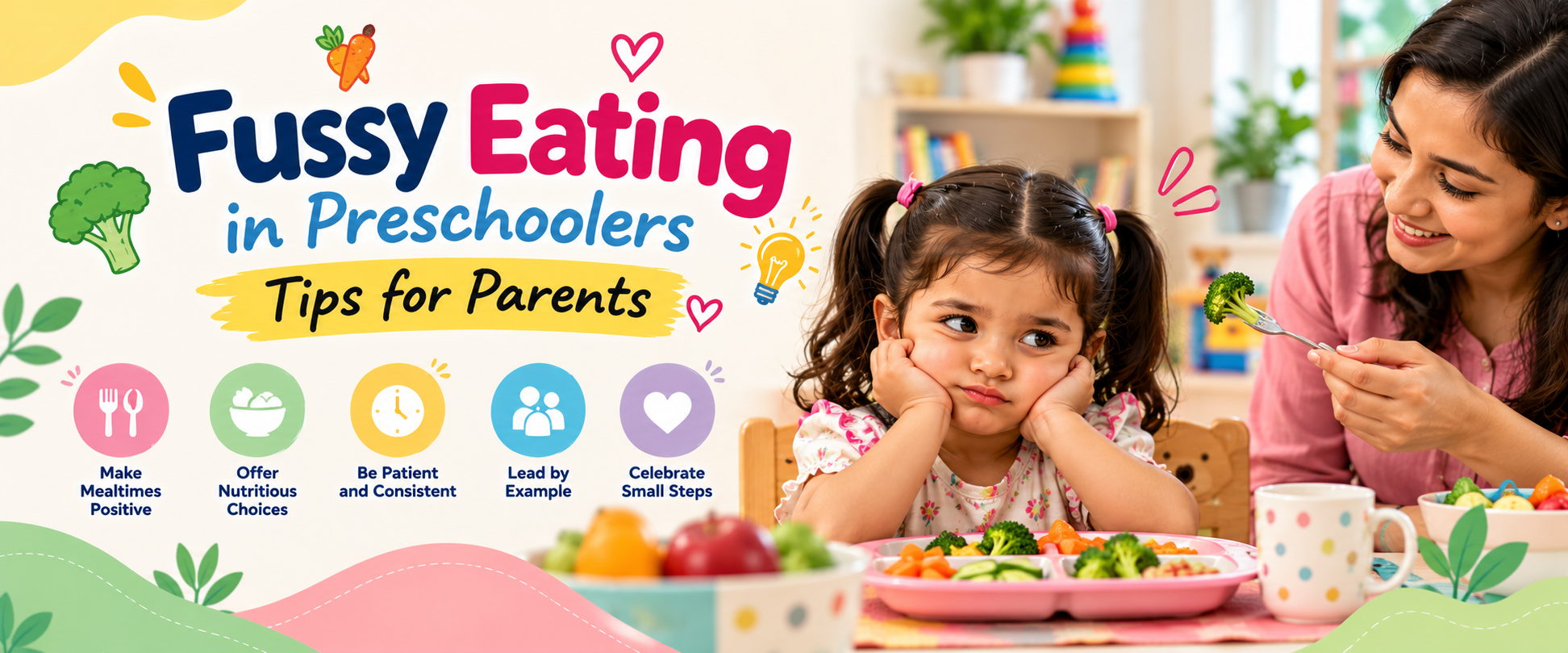
My Child Won’t Eat Properly: Simple Ways to Handle Fussy Eating in Preschoolers
If your preschooler takes one look at a lovingly cooked plate and announces “I don’t want this!”, you are not alone. Fussy eating is one of the most common and most exhausting phases of early parenting. Here is a calm, practical guide to understanding why it happens and how to make mealtimes work for your whole family, built on everyday Indian food and real-life rhythms.
“Just one more bite!”
You have spent time preparing a nutritious meal. The dal is ready. The roti is soft. The vegetables are cooked just right. Everything is served warm. Your preschooler takes one look at the plate, declares “I don’t want this!”, and asks for a biscuit instead. You try explaining why vegetables are important. You offer curd. You promise a sweet if they finish. Perhaps you even switch on a cartoon, hoping a few distracted bites will somehow make their way into that little mouth. Before you know it, lunch has turned into a long negotiation. If this sounds familiar, take a deep breath. You are far from alone.
Fussy eating in preschoolers is one of the most common parenting concerns worldwide, and particularly common in households where food is a strong expression of love and care. Between the ages of two and five, children are becoming more independent, discovering their own preferences, and learning to make choices. Food is one of the first and loudest places where they practise all three. One day your child happily eats a particular vegetable. The next day, that same vegetable is completely unacceptable. They may insist on eating only rice for a week, reject anything that looks unfamiliar, or survive what feels like an entire day on a few bites and a glass of milk. It can be genuinely frustrating, particularly when you are worried about your child’s nutrition and growth.
The good news is that healthy eating habits are built over months and years, not in a single meal. With patience, a predictable routine, and a calmer approach to food, parents can help preschoolers become more comfortable with a wider variety of foods, without turning every lunch into a battle. For parents searching for the best play school in Ghaziabad that understands how early habits shape lifelong wellbeing, this topic is more important than it sometimes seems.
Children do not refuse food to be difficult. They refuse because they are small people with still-developing taste buds, newly discovered opinions, and tiny stomachs that react differently to different days. Understanding why they are refusing is often the first step towards a happier dining table for everyone.
Why Is My Preschooler Such a Fussy Eater?
Before trying to change your child’s eating habits, it genuinely helps to understand what might be happening underneath the refusal. Fussy eating almost always has a reason, and knowing the reason often changes how you respond.
-
1
Your child is discovering independence
Preschoolers are at the age where they want to do things themselves. They want to choose their clothes, decide which toy to play with, and sometimes insist on doing everything without any help. Food becomes another way of expressing that growing independence. When a child says “I don’t want that”, they may not actually be rejecting the food because it tastes bad. They may simply be exploring their newfound ability to make choices and have them matter.
Instead of turning every refusal into a battle, offer limited, age-appropriate choices. “Would you like your roti cut into small pieces or rolled up?” “Would you like dal on your rice or next to it?” This gives your child a sense of control over something, while keeping the actual meal within the boundaries you set.
-
2
New foods can feel genuinely unfamiliar
Young children are often cautious about unfamiliar foods, including their appearance, smell, texture, and temperature. This is sometimes called food neophobia, the reluctance to try new foods, and it is a completely normal part of development. Some children prefer foods that look exactly the same every time. A change in the shape of a sandwich, a different brand of biscuit, or a new vegetable on the plate can lead to immediate refusal, not because the food is bad but because it is unfamiliar.
Rather than insisting your child eat a new food immediately, introduce it gradually. Let them look at it, touch it, smell it, or see other family members enjoying it. Exploring food in this low-pressure way is genuine progress, even when actual tasting comes much later.
-
3
Their appetite is often smaller than you think
Growth is very rapid during infancy, but the rate of growth typically slows down during the preschool years. As a result, children’s appetites can vary dramatically from one day to the next. Your child may eat a hearty breakfast one morning and barely touch lunch. On another day, they may seem hungry all afternoon. This variation usually does not mean something is wrong. It is far more useful to look at your child’s overall eating pattern across the week, their energy levels, and their growth over months than to judge their nutrition by one meal.
-
4
Too many snacks can quietly ruin mealtimes
A biscuit here, a packet of chips there, a sweet drink after playtime, a favourite snack just before dinner. Children have small stomachs, so frequent grazing can genuinely reduce their appetite when a proper meal is finally served. This does not mean snacks are bad. Healthy snacks are an important part of most preschoolers’ diets. The key is to offer them at reasonably predictable times, with enough gap between eating occasions for your child to actually feel hungry again before the next meal.
-
5
Food has become a source of pressure
When parents worry about nutrition, it is completely natural to encourage a few extra bites. However, repeated pressure, bargaining, scolding, or forcing a child to eat can make mealtimes feel stressful rather than nourishing. A child may begin associating the dining table with conflict instead of comfort. The goal is not to make your child finish every single item on the plate. It is to help them learn to recognise their own hunger and fullness, explore different foods at their own pace, and gradually develop a balanced eating pattern that lasts for life.
10 Practical Ways to Handle Fussy Eating
You do not need elaborate recipes, expensive imported ingredients, or a completely separate menu for your child. Small, consistent changes made across weeks tend to make a far bigger difference than any single dramatic intervention. Here are ten approaches that actually work for families with preschoolers.
-
1
Establish a predictable meal and snack routine
Children feel more secure when they know what to expect. A reasonably consistent rhythm of breakfast, lunch, an evening snack, and dinner helps regulate their hunger and quietly reduces constant requests for food between meals. Your family’s exact timings will depend on your child’s school schedule, sleep, and activity, but avoid letting them graze continuously throughout the day, and offer water rather than snacks between eating occasions. A routine should provide structure, not become a rigid rule that ignores genuine hunger.
-
2
Stop turning every meal into a negotiation
“Finish your vegetables and then you can have dessert.” “Eat five more spoons for Mumma.” These phrases are second nature in most Indian households, but research consistently shows that using rewards to persuade children to eat can backfire. The less-preferred food starts to feel like a chore. The reward feels even more desirable than before. And the child learns to associate eating with winning or losing rather than nourishment.
“Finish your sabzi, then dessert.”→“You don’t have to finish. Listen to your tummy and tell me when you feel full.”This gentler approach helps children gradually learn to recognise their own hunger and fullness cues, which is a skill that genuinely lasts a lifetime.
-
3
Introduce new foods without pressure
A child may need many quiet, low-pressure opportunities to become familiar with a new food before they feel ready to taste it. There is no fixed number that works for every child, so patience matters more than counting attempts. If your child rejects spinach today, you do not need to give up on spinach forever. Try again on another day. Serve it in a familiar preparation, next to foods your child already enjoys. Let them see it, smell it, or touch it without demanding they eat it. Avoid relying only on disguising vegetables inside other foods. While that strategy has its place, children also benefit from gradually learning to recognise and accept different foods in their own right.
-
4
Make familiar Indian foods work for your family
Healthy eating does not require expensive imported ingredients, complicated meal plans, or completely separate food for adults and children. Everyday Indian foods already offer tremendous variety and nourishment when planned thoughtfully. If your child prefers plain rice, serve a small portion of rice alongside dal and a familiar vegetable rather than expecting them to accept an entirely new dish all at once. The aim is to expand variety gradually, while keeping meals familiar and manageable within what your household already cooks.
-
5
Let your child see you enjoying healthy food
Children notice what adults do far more than we sometimes realise. If you regularly eat vegetables, fruit, pulses, and other nutritious foods, your child gets daily opportunities to see these as an ordinary, enjoyable part of family life. Try sitting together for at least some meals whenever practical. Eat the same family foods where possible, adapting texture and seasoning to your child’s needs. You do not have to pretend to love every vegetable. Simply model a balanced approach to food, and avoid labelling foods as “disgusting”, “terrible”, or “something to be endured”. Family meals are also about connection. A conversation about a favourite story, a funny moment from school, or weekend plans takes attention away from counting bites.
-
6
Give children age-appropriate independence in the kitchen
Children are often far more willing to engage with food when they feel involved in making it. Invite your preschooler to wash a fruit, choose between two vegetables, arrange soft fruit pieces on a plate, or help mix ingredients under supervision. At the table, offer a child-sized spoon or fork and allow them to practise feeding themselves. Mess is part of learning. A little spilled dal or an unevenly arranged plate is a small price to pay for developing coordination, confidence, and independence. Always supervise closely around sharp utensils, hot surfaces, and choking hazards.
-
7
Make the plate inviting, not overwhelming
A plate piled high with food can feel genuinely intimidating to a small child, particularly when some items are unfamiliar. Start with small portions. Your child can ask for more if they are hungry. Try including at least one familiar food alongside anything new being offered. This does not mean cooking a different dinner every time your child refuses something. It simply provides a comfortable starting point while you continue to offer variety. Colourful plates and simple presentation can encourage curiosity, but you do not need to turn every meal into an elaborate animal-shaped creation. The purpose is to make food approachable, not to entertain through every bite.
-
8
Reduce distractions during meals
Cartoons, mobile phones, and tablets at mealtimes can keep a child seated, but they also distract them from the experience of eating and from noticing their own hunger and fullness cues. Wherever possible, make mealtimes a screen-free family activity. Keep the atmosphere relaxed. Talk to your child about their day. Allow reasonable time to eat without monitoring every mouthful. If your child has sensory, developmental, or other needs that make mealtimes more complicated, an individualised approach is appropriate, and persistent concerns deserve a conversation with a qualified professional rather than another parenting strategy.
-
9
Avoid comparing your child with others
“Look at your cousin, he finishes everything!” “You are the only one who refuses vegetables.” These comments may seem harmless, but they can create real shame and make a child feel that eating is a test they are failing. Children differ enormously in appetite, preferences, development, and comfort with unfamiliar foods. Even siblings in the same family can have very different eating patterns. Focus on your own child’s progress. Perhaps they touched a new food today, sat with the family for longer than usual, or tried a small taste after refusing it several times. Celebrate curiosity and effort without turning food acceptance into a performance.
-
10
Know when to step back, and when to seek help
Not every meal needs to end with an empty plate. A child who eats less at one meal may be hungry at the next scheduled eating occasion. If your child refuses dinner, remain calm and follow your family’s usual routine. Avoid immediately preparing an endless series of alternative meals, while also making sure the overall routine responds to genuine hunger. At the same time, persistent food refusal is not always just normal pickiness. If something feels wrong over weeks, it is worth checking in with a paediatrician.
Everyday Indian Meal Ideas That Actually Work
These are ideas, not a compulsory menu. Your child’s nutritional needs, allergies, cultural preferences, and chewing abilities should guide your actual food choices. These are simply starting points that work well for most preschoolers in Indian households, built from foods most families already cook on a regular basis.
- Idli with sambar
- Vegetable poha
- Dosa with chutney
- Besan chilla
- Suitable warm porridge
- Paratha with curd
- Dal and rice
- Roti with vegetable preparation
- Curd rice
- Khichdi with suitable accompaniment
- Rajma or chole with soft rice
- Mixed vegetable rice
- Fresh fruit pieces
- Plain yoghurt
- Suitable homemade snack
- Soft, age-appropriate cooked vegetables
- Dhokla or steamed snacks
- Milk-based preparations
- Vegetable pulao with curd
- Dal with roti
- Soft paneer preparations
- Simple family thali in small portions
- Soft upma or semolina dishes
- Vegetable soup with roti pieces
Who Decides What: The Division of Responsibility
One of the most useful ideas in child-feeding research is the simple principle that adults and children each have their own clear role at mealtimes. When those roles stay separate, everyone tends to relax. When they get mixed up, mealtimes often become stressful for everyone involved.
The Division of Responsibility at Mealtimes
- What foods are offered
- When meals and snacks happen
- Where the family eats together
- What the overall routine looks like
- What is reasonable to serve
- Whether to eat what is offered
- How much of it to eat
- Which parts of the plate to start with
- When they feel genuinely full
- What their body is telling them
When parents respect this split, children stop feeling controlled at the dining table, and parents stop feeling defeated when a child does not eat everything served. Both sides can relax into their own job. Over months, children raised this way tend to develop a much healthier internal sense of hunger and fullness, which protects them against overeating, undereating, and anxious food behaviours well into adulthood.
The Journey From “No!” to “Can I Try?”
Introducing a new food is not a one-step event. It is a slow journey, and understanding the stages helps parents stay patient when progress feels invisible. Here is what the typical path from refusal to acceptance actually looks like in a preschooler.
This journey often takes weeks, sometimes months. Each small step is genuine progress, even when it looks like nothing is happening. The child who touched a new vegetable today is quietly ahead of where they were last week. The child who smelled something unfamiliar has moved another step forward. Celebrate the small movements, and resist the urge to collapse the whole journey into a single meal.
How Much Should a Preschooler Actually Eat?
One of the biggest worries parents have is whether their child is eating enough. The honest answer is that there is no single portion size that suits every preschooler. Appetite depends on age, growth, activity, sleep, health, and what the child has already eaten throughout the day. Children are also remarkably good at regulating their own intake over several days when the pressure is removed and the food offered is reasonably balanced.
Rather than insisting on a fixed number of spoonfuls, begin with small portions and allow your child to ask for more. Offer a variety of foods across the day and the week, including suitable sources of carbohydrates, protein, healthy fats, vitamins, and minerals. Try not to judge your child’s intake by comparing their lunch plate with their classmates’ or their cousins’. A more useful picture comes from the overall pattern of eating across a week, the child’s energy and development, and their growth over months. If you are unsure whether your preschooler is getting enough nutrition, your paediatrician can review their growth and discuss their diet with you.
Helping Your Child Build a Healthy Relationship With Food
Healthy eating is not only about what goes onto the plate. It is also about the feelings, habits, and experiences that surround food in your home. Children can gradually learn that meals are a normal part of the day, that new foods are worth exploring, and that they can listen to their own bodies without being pressured to finish everything. These simple principles, applied patiently over years, matter far more than any single lunch.
-
Keep mealtimes reasonably predictable. Children thrive on knowing when the next eating occasion will be.
-
Offer variety without demanding every food be tasted. Exposure matters even when acceptance takes months.
-
Let children decide whether and how much to eat. Adults set the menu. Children set the appetite.
-
Avoid using food as punishment, bribery, or a measure of good behaviour. These links tend to haunt children later in life.
-
Make family meals pleasant opportunities for connection. Talk about anything other than how much everyone is eating.
-
Seek professional guidance when eating difficulties persist. Not every fussy phase is just a phase, and real help exists when it is needed.
The aim is not to create a child who eats everything without question. It is to nurture a child who can gradually explore different foods, recognise their own needs, and approach mealtimes with calm confidence instead of anxiety.
When Fussy Eating Needs More Attention
Most fussy eating in preschoolers is a normal developmental phase that improves with patience and a steady routine. But sometimes what looks like ordinary pickiness is actually a signal of something that deserves professional attention. Being aware of these signs helps parents know when to seek help rather than struggle on alone.
Signs worth discussing with your paediatrician
- Ongoing poor weight gain, weight loss, or a drop in growth percentile
- Unusual or persistent tiredness without clear cause
- Persistent constipation or other digestive symptoms
- A diet that is becoming increasingly restricted over time
- Eating that causes significant distress or takes unusually long
- Difficulty chewing or swallowing, recurrent vomiting, or frequent gagging
- Pain during eating, or refusal to eat specific textures entirely
A paediatrician can assess growth and general health and, if needed, refer you to a registered dietitian, feeding therapist, or other appropriate specialist. Early support is almost always easier than later intervention.
Urgent: Choking or breathing difficulty during a meal requires immediate medical attention. Learn age-appropriate first aid for choking, and never leave a young child unsupervised with hard, round, or small foods that pose choking risks.
The Role of Preschool in Healthy Eating Habits
Young children learn through repetition, observation, and everyday experiences. The habits practised at home are quietly reinforced by every other environment the child spends time in, and preschool is one of the most important of those environments. A positive preschool setting supports healthy routines, independence, calm social eating, and openness to trying new things, all through daily low-pressure exposure.
What preschool realistically can and cannot do
A thoughtful preschool reinforces the family’s efforts. It provides a predictable snack and meal routine, calm adult modelling, age-appropriate conversations about food, and opportunities for children to practise self-help skills like opening a tiffin, using a spoon, and sitting through a meal with friends.
A good preschool does not pressure children to eat, shame them for refusing food, or treat one mealtime strategy as the answer for every child. Parents should always ask about the school’s actual food policies and arrangements, particularly when a child has allergies, dietary restrictions, or additional support needs. The partnership works best when it rests on genuine understanding, patience, and shared commitment to the child’s wellbeing.
When families and educators communicate openly, they can work towards consistent expectations that help the child feel secure in both environments. A child who sees calm, routine eating at school often becomes slightly calmer at home too. The reverse is also true, which is why the home side of the partnership matters just as much.
A Final Word: You Are Not Failing at Mealtimes
If your child has ever pushed away a lovingly prepared meal, refused vegetables for the fifth time, or declared they no longer like a food they happily ate yesterday, remember this. You are navigating one of the most common and most normal parts of early childhood. You do not need to win every mealtime battle. You do not need to prepare five different dinners. And you certainly do not need to measure your parenting by the number of bites your child takes on any given day.
Start with a routine. Offer variety. Model the habits you want your child to learn. Give them room to explore food at their own pace. Keep the dining table a place of connection rather than conflict. Pay attention to the bigger picture over months, not individual meals. And if your child’s eating is persistently restricted, distressing, or affecting growth, seek professional advice rather than struggling through it alone. Everything else is just practice.
How The Little Scholar Supports Healthy Food Habits
At The Little Scholar Playschool in Kavi Nagar, Ghaziabad, mealtimes and snack times are treated as genuine opportunities for the kind of calm, confident learning that shapes a child’s lifelong relationship with food. The school’s approach is deliberately low-pressure. Children are never shamed for not finishing, never pressured to taste something they are not ready for, and never compared to their classmates on how much they ate.
What children do experience is a predictable rhythm of eating occasions, warm adult modelling of calm and healthy eating, age-appropriate conversations about food, and daily practice of self-help skills like opening tiffins, using spoons, and sitting at the table with friends through a full meal. Children see other children eating. They absorb the ordinary normalcy of different foods on different plates. They slowly become more comfortable with variety, not because an adult insisted but because they watched it happen around them day after day.
The school also communicates openly with families about each child’s eating patterns, allergies, dietary needs, and any individual sensitivities. When home and school share the same calm approach, children settle into healthy eating habits far more quickly than when either side goes alone. The partnership matters.
Parents searching for the best play school in Ghaziabad that takes the whole child seriously, including the complicated reality of fussy eating, often mention this gentle, patient approach as one of the reasons they choose The Little Scholar. Read what Ghaziabad families say on their Google Business profile.
Give Your Child a Preschool That Treats Mealtimes With Care
If you want a preschool where your child’s eating habits, independence, and emotional comfort are supported with the same care as their academic learning, the team at The Little Scholar Playschool Kavi Nagar would love to welcome your family. Book a school visit or fill the admission inquiry form.
Frequently Asked Questions
Is fussy eating normal in preschoolers?
Fussy eating is very common during the preschool years. Children often become more independent, more cautious about unfamiliar foods, and more inconsistent in their appetites between the ages of two and five. However, severe or persistent food restriction, poor growth, swallowing difficulties, or significant distress around eating should be discussed with your paediatrician.
How can I get my preschooler to eat vegetables?
Offer vegetables repeatedly without pressure, serve small portions alongside familiar foods, and let your child see family members enjoying them. Allowing children to wash vegetables, choose between two options, or help with simple food preparation can also encourage genuine curiosity. Avoid forcing bites or treating vegetable-eating as a test the child can fail. Most children slowly accept more variety when the pressure is removed.
Should I force my child to finish their plate?
No. Forcing a child to finish a meal can increase stress and make it harder for them to recognise their own hunger and fullness cues. Offer appropriate portions and a balanced selection of foods, then allow your child to decide how much to eat from what is offered. If you are concerned about inadequate intake or growth, consult a paediatrician rather than increasing mealtime pressure.
What if my child only wants milk or snacks?
Review the timing and quantity of milk and snacks with your paediatrician if your child’s diet is becoming limited. Frequent grazing can genuinely reduce appetite for meals, so a predictable eating routine often helps. Offer water between eating occasions and serve age-appropriate meals and snacks. Do not abruptly restrict important sources of nutrition without professional guidance.
How many times should I offer a new food before giving up?
There is no exact number that works for every child. Some children need many low-pressure exposures to become familiar with a new food. Offer it again on different occasions, perhaps in a familiar preparation, without insisting they taste it. Even looking, touching, or smelling counts as progress. If the child’s diet is becoming increasingly narrow or food causes significant distress, seek professional advice.
When should I worry about my child’s fussy eating?
Consult your paediatrician if you notice weight loss, poor growth, persistent low intake, unusual tiredness, ongoing digestive problems, difficulty chewing or swallowing, recurrent vomiting, or a very restricted diet that affects daily life. Seek urgent help for choking or breathing difficulty during a meal.
How can preschool help children develop healthy eating habits?
A supportive preschool environment reinforces routines, independence, calm social eating, and positive everyday habits. Families should ask the school about its actual mealtime practices and communicate any allergies, dietary restrictions, or individual needs. Home and school working together, without pressure or shame, supports the child’s wellbeing far more effectively than either side alone.
What are some healthy snack ideas for preschoolers?
Depending on your child’s age, abilities, and dietary needs, options include soft fruit pieces, plain yoghurt, suitable homemade snacks, soft cooked vegetables, dhokla, idli, or other nutritious preparations. Avoid hard, round, or otherwise hazardous foods unless prepared safely for the child’s developmental stage. Always supervise young children while they eat.
What makes The Little Scholar the best play school in Kavi Nagar Ghaziabad for supporting healthy eating?
The Little Scholar Playschool in Kavi Nagar, Ghaziabad treats mealtimes as calm, learning opportunities rather than performance moments. Children are never shamed for not finishing or pressured to taste things they are not ready for. Instead, they experience predictable rhythms, warm adult modelling, and plenty of time to settle into healthy eating habits at their own pace. The school also communicates openly with families about allergies, preferences, and individual needs. Read parent reviews on their Google Business profile.
This article provides general parenting information and is not a substitute for individual medical or nutritional advice. For specific concerns about your child’s eating, growth, or health, please consult a qualified paediatrician or registered dietitian.
Raising a Healthy Eater, One Day at a Time
Raising a healthy eater is not about getting every meal right. No parent manages that, and the ones who seem to usually have simply learned not to count. It is about building a positive relationship with food over months and years, through hundreds of calmer meals and dozens of patient reintroductions. Most fussy phases pass. Most children slowly expand what they are willing to try. And most families eventually look back and realise the difficult food year was really just a stage in a much longer story.
For families in Ghaziabad looking for a preschool that understands that food, like learning, is something that grows best in a warm, low-pressure environment, the right school can make a real difference to how the week feels at home too. A child who eats calmly at preschool tends to carry some of that calm back to the family dinner table, and the whole household breathes a little more easily as a result.
You are not failing at mealtimes. You are teaching your child a relationship with food that will last for the rest of their life. That is slow, patient work, and it is some of the most important work parenting ever asks of us.