
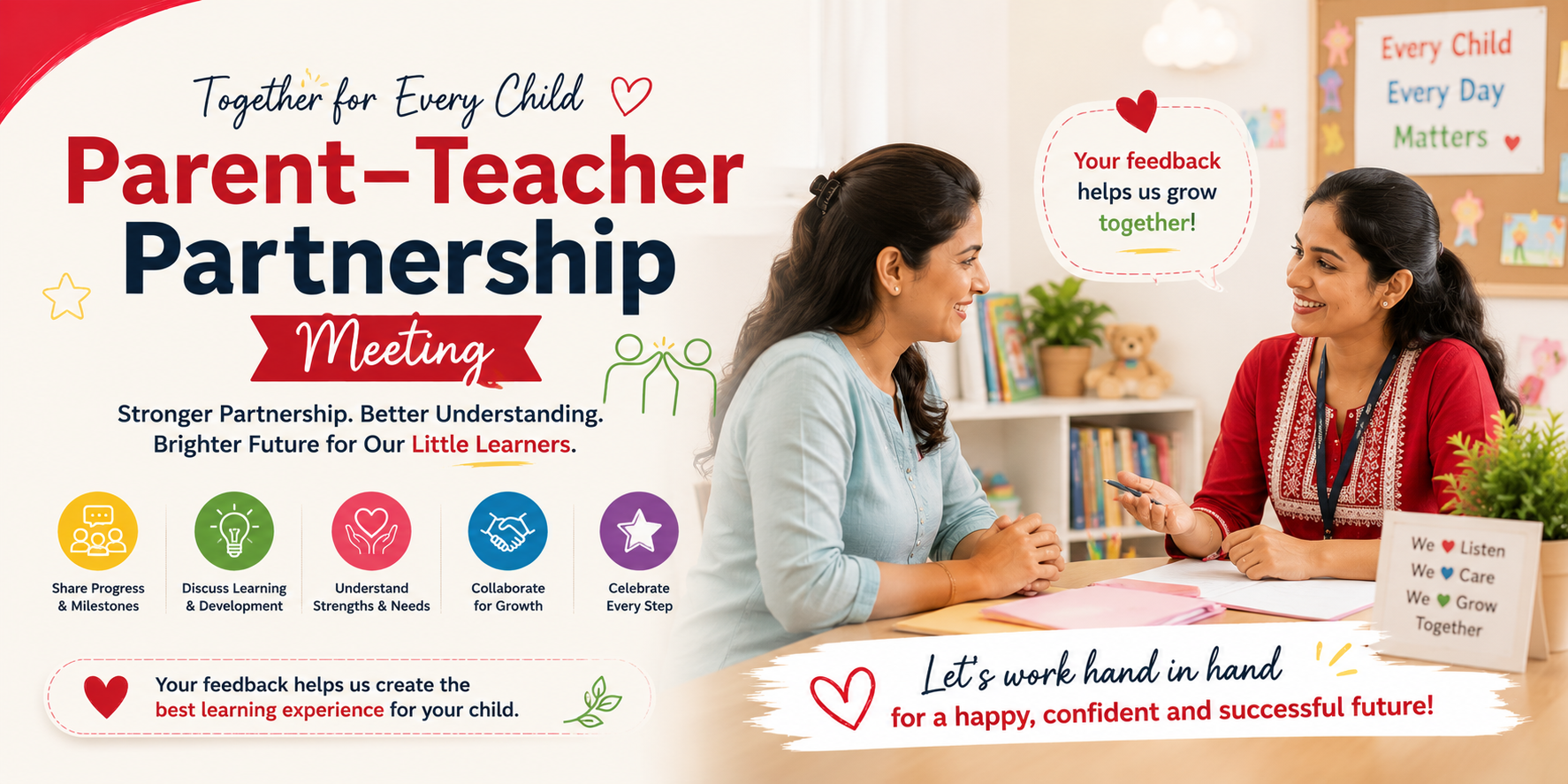
Parenting · Parent-Teacher Partnership · Best Play School in Ghaziabad
How Parents Can Work With Teachers: Turning Preschool Feedback Into Better Learning and Development
The most powerful relationship in your child’s early education is not parent versus teacher. It is parent plus teacher. Here is how to receive feedback without defensiveness, communicate as partners, and turn every observation into progress for your child.
A Sentence That Makes Many Parents Defensive
“We have noticed something about your child.”
It may be about speech. Attention. Friendships. Behaviour. Independence. Eating. Participation. Or the way a child responds to frustration. Whatever the topic, that opening line has a way of putting most parents on their heels. The first instinct is often to explain.
- “My child doesn’t do that at home.”
- “They’re just tired.”
- “They’re very active.”
- “They’re shy with new people.”
Sometimes the teacher may indeed be seeing only one side of the child. But there is another possibility that deserves equal consideration. The teacher may have noticed something the parent has not. And the parent almost certainly knows something about the child that the teacher does not. That is why the most powerful relationship in early childhood education is not parent versus teacher. It is parent plus teacher.
Together, parents and teachers see more of the child than either can see alone. A child spends different parts of the day in different environments, and each environment reveals different sides of who they are becoming. When those two perspectives come together respectfully, small concerns become opportunities. Missed signals become early support. Small friction points become growth.
A Teacher’s Concern Is Not a Verdict
Language matters more than most of us realise. When a teacher says “your child is finding it difficult to participate in group activities,” that is an observation. It is not a diagnosis and not a permanent label. When a teacher says “your child needs reminders to wait for a turn,” that is information the parent can work with. It is not a criticism of parenting or of the child. When a teacher says “we have noticed your child is quieter than usual,” that is an invitation to understand what may be happening in the child’s life right now.
The healthiest first response is not to defend, and not to worry. It is to be curious. Ask questions that pull out useful details.
- What have you observed exactly?
- When does it happen?
- Is it happening every day?
- What seems to help?
These questions do not commit the parent to accepting the observation as the final word. They just gather enough information to make sense of it. And in most cases, they turn what could have been an awkward conversation into a genuinely useful one.
Why Teacher Feedback Matters in Preschool
Teachers observe children in a social environment that parents cannot always see. A child may behave differently at home and school, and that is completely normal. It does not mean either side is wrong. It means the child is a whole person with different sides that show up in different places.
What Teachers See
The social self
- How they interact with peers
- How they respond to group instructions
- Whether they ask for help
- How they handle transitions
- Whether they can wait for a turn
- How they respond to losing or making mistakes
- How independently they manage routines
- Whether they participate in activities
- How they communicate emotions to peers
What Parents See
The intimate self
- Family conversations and dynamics
- Sibling relationships
- Sleep patterns and quality
- Eating habits
- Reactions to change at home
- Deep interests and hidden fears
- Behaviour after a long day
- What genuinely motivates them
- Emotional patterns over months
Neither perspective is complete on its own. Together, they create a much fuller picture of who this child is and what they need right now. When adults on both sides trust that they each hold half the picture, the conversations that follow tend to be more useful for the child.
19 Principles for a Genuine Partnership
None of what follows is complicated. But taken together, these principles change how parent-teacher relationships actually work and, more importantly, how much they help the child.
-
1
Listen Before You Explain
When a teacher raises a concern, pause. Instead of jumping to “they don’t do that at home,” try “can you tell me more?” Ask for examples. Ask when it happens and how often. Ask whether it occurs with specific activities. This is not about accepting every observation without question. It is about gathering information before reaching a conclusion.
-
2
Ask What They Have Actually Observed
Good feedback should be specific. There is a major difference between “your child is inattentive” and “during group storytelling, your child listens for about five minutes and then starts looking around or talking to nearby children.” The second gives you something concrete to understand and work with. It is completely appropriate to ask a teacher for that level of detail.
-
3
Look for Patterns, Not One-Off Incidents
Every child has difficult days. They may be tired, hungry, overstimulated, missing home, unwell, or excited about something. One incident does not define a child. If a concern shows up repeatedly across different days and activities, it becomes worth exploring. If it does not, it may simply have been a hard afternoon.
-
4
Share What Is Happening at Home
Teachers cannot see what happens after school. If your child has recently experienced a major change in routine, travel, family circumstances, sleep disruption, a new sibling, illness, or another significant transition, sharing appropriate context can help the teacher interpret behaviour more accurately. You do not need to share every private detail. But relevant context is genuinely useful information.
-
5
Ask What the School Is Already Doing
Before introducing something new at home, ask what the teacher is trying in class. “Does sitting closer to the teacher help?” “Does a warning before transitions help?” This matters because consistency is powerful. If school uses one approach and home uses a completely different one, the child receives mixed messages, and neither approach works as well as it could.
-
6
Work on One or Two Goals at a Time
The temptation after a parent-teacher meeting is to try to fix everything at once. This overwhelms everyone, especially the child. Choose one or two practical goals instead. Asking for help instead of crying. Putting belongings away independently. Waiting for a turn. Small goals are much easier to practise, notice, and celebrate. Progress on a few things beats stalled effort on many.
-
7
Ask How You Can Support at Home
A genuinely useful question is “what can we practise at home that would support what you are doing in school?” The teacher might suggest reading together, role-playing conversations, practising turn-taking, giving simple responsibilities, using emotion words, encouraging independent dressing, or preparing the child for transitions. This is not homework being assigned. It is development being integrated into normal family life.
-
8
Do Not Turn Feedback Into a Lecture at Home
How you translate teacher feedback for your child matters enormously. Avoid framing that becomes a label the child absorbs about themselves.
“Your teacher says you are selfish.”→“Let’s practise taking turns.”“Why are you so shy?”→“Would you like to practise telling me your story?”Correct the behaviour without defining the child by it. The child should never come to believe they are “the shy one” or “the difficult one” based on how adults describe them at home.
-
9
Never Shame a Child for Teacher Feedback
A preschooler should not feel that adults are discussing them as if they are a problem to be fixed. Feedback should become support the child can feel. The message should be “we noticed something. Let’s help you.” Not “something is wrong with you.” Children are still building their sense of who they are, and the language adults use in these years becomes the language children eventually use about themselves.
-
10
Celebrate Progress With Teachers
Feedback should not only happen when something is going wrong. If a teacher says “she waited for her turn today,” or “he participated in the group activity,” or “she asked for help instead of crying,” notice it and celebrate it. Positive feedback is powerful because it tells children that adults notice effort and improvement, not only mistakes. Ask teachers to share the good moments too, not just concerns.
-
11
Understand That Development Is Not Linear
Children rarely develop in a perfectly straight line. A child may become independent in one area and need help in another. They may speak confidently one month and become quiet during a transition. They may make excellent progress with sharing and then struggle again when tired. This does not automatically mean something is wrong. Development moves in phases, and small regressions are often the pause before a bigger leap.
-
12
Know When to Take a Concern More Seriously
Parents and teachers should pay closer attention when a concern is persistent, significantly affects daily functioning, appears across settings, or represents a noticeable change from the child’s previous behaviour. Examples might include persistent withdrawal, significant communication difficulties, prolonged distress, major behaviour changes, or loss of previously developed skills. In these cases, discussing the concern with a paediatrician or qualified child development professional is worthwhile. The goal is early understanding, never labelling.
-
13
Give Teachers Feedback Too
The partnership must work in both directions. Parents should tell teachers what works well for the child, what motivates them, what helps when they are upset, what they are currently learning at home, and whether there are situations that make them uncomfortable. This information helps teachers individualise their approach. A teacher may discover a child who avoids an activity becomes engaged when given a particular role. A parent may discover a child who refuses something at home participates happily when introduced through a group game. Both sides learn.
-
14
Ask for Solutions, Not Just Problems
A productive parent-teacher conversation should end with a plan, not just a shared worry. Instead of asking “why is my child doing this?” ask “what can we try?” and “who will do what?” and “when should we review progress?” This is what turning feedback into an action plan actually looks like.
Example plan after a feedback conversation
GoalChild will ask for help using words rather than cryingAt SchoolTeacher will prompt the child with a specific phraseAt HomeParents will role-play asking for help in daily situationsReviewDiscuss progress after two weeks -
15
Build a “Same Message” Environment
Children benefit enormously when important values and expectations get reinforced in both places. This does not mean the environments should be identical. It means the underlying messages should be consistent, so the child does not have to figure out which version of the world applies where.
At School“We use kind words.”+At Home“We also use kind words with family members.”At School“We put materials away.”+At Home“We also put toys away when we’re done.”At School“We ask before taking.”+At Home“We ask before using someone else’s things.” -
16
What If Parents Disagree With the Teacher?
Disagreement is completely normal. Parents know their children deeply. Teachers have professional experience and classroom observations. Both perspectives are valid. If you disagree, do not turn the conversation into a confrontation. Ask “can you help me understand what you are seeing?” or “could we observe this for a little longer?” or “what alternative approaches could we try?” A respectful disagreement, worked through together, often leads to better understanding than easy agreement would have.
-
17
What If the Feedback Feels Too Negative?
You can ask for a more balanced picture. “What are my child’s strengths?” “What is going well?” “What is one area we should focus on?” These questions shift the conversation from criticism to development. Strengths are not separate from challenges. Sometimes a strength is part of the solution. A highly energetic child may just need more movement built into their day. A very observant child may need extra time before participating. A sensitive child may respond well to predictable routines. Individualisation is at the heart of quality early childhood education.
-
18
Teachers Need to Feel Supported Too
Parent-teacher partnership is not only about what teachers can do for parents. Teachers need respectful communication back. “Thank you for noticing this.” “Let’s work together.” “Please tell us if you see a pattern.” These small phrases create trust. When teachers feel that parents will listen rather than immediately become defensive, they raise concerns earlier, which is almost always better for the child than delayed communication.
-
19
The Goal Is Not a “Perfect” Child
This is perhaps the most important point of all. Children are not projects to be perfected. They are people to be understood. The goal of parent-teacher collaboration is not to produce a quiet, obedient, academically advanced child identical to every other child in the class. The goal is to help each individual child become more confident, capable, socially connected, and emotionally secure than they were last month.
Ask for helpExpress feelingsTry againMake friendsSolve problemsTake responsibilityAccept feedbackLearn from mistakesShow kindnessEnjoy learningThat is what real progress looks like at this age.
The CARE Framework for Every Feedback Conversation
When you sit down for any conversation with your child’s teacher, keep this simple five-step framework in mind. It works for scheduled parent-teacher meetings, for a quick pickup-time conversation, and for anything in between.
The CARE Approach
Then agree on a review date. This one habit alone changes the tone of feedback conversations more than almost anything else. It moves them from moments of worry to moments of planning, which is exactly what they should be.
Better Questions to Ask at Every Parent-Teacher Meeting
Most parents walk into a parent-teacher meeting with a single question in mind: “how is my child doing?” That question is fine, but it usually produces a general answer that does not help much. A richer set of questions produces a much richer picture of your child.
Ask these instead of “how is my child doing?”
- What are my child’s strongest qualities right now?
- What do they seem to enjoy most in the classroom?
- Where do they participate most confidently?
- Are they making friends? What are those friendships like?
- How do they respond when they are frustrated?
- Do they ask for help when they need it?
- How independent are they with daily routines?
- Is there anything you would like us to practise at home?
- What progress have you noticed in the last few weeks?
- What should we focus on together over the next few weeks?
These questions treat the teacher as someone who has genuinely spent time with your child. They also give you a fuller sense of who your child is when you are not around, which is often quite revealing.
A Note for Teachers on Sharing Feedback Well
The responsibility for a healthy partnership is genuinely shared. Teachers can make their feedback dramatically more effective by paying attention to how it is delivered.
The difference between unhelpful and helpful feedback is often just how it is worded.
The first sentence gives a parent something to worry about. The second gives them something to work with. That difference matters more than most people realise.
The Biggest Shift a Parent Can Make
Perhaps the biggest single shift any parent can make is to stop hearing teacher feedback as a judgement of their parenting. It is not. Feedback is information. Sometimes it confirms what you already know about your child. Sometimes it reveals something new that you had not seen. Sometimes it challenges your assumptions in a useful way. And sometimes it gives you an opportunity to help your child develop a skill before a small challenge becomes a bigger one.
The best parent-teacher relationship is not one in which everyone always agrees. It is one in which everyone is willing to listen. Because when parents listen to teachers, teachers listen to parents, and both listen carefully to the child, something powerful happens. The child feels supported from both sides. And that is the environment in which children genuinely learn, grow, and flourish.
How The Little Scholar Playschool Builds This In
At The Little Scholar Playschool in Kavi Nagar, Ghaziabad, parents are treated as partners in every part of the child’s early education, not as outsiders receiving reports. The role of the school is not simply to tell parents what their child did that day. It is to understand the child, notice their strengths, celebrate their progress, identify where they may need encouragement, and work collaboratively with families to support them.
Feedback here is never about blaming a child or a parent. It is always about finding solutions together. A child who is struggling with something today may develop remarkable confidence tomorrow when the adults around them respond with patience, consistency, and understanding. That understanding cannot come from one side alone. It requires both.
The school maintains regular, honest, warm channels of communication between teachers and parents. Individual conversations happen whenever needed, not only at scheduled meetings. Developmental updates are specific and constructive. Parents are invited into school life through storytelling sessions, cultural celebrations, and volunteering opportunities. Every communication returns to one shared question: how can we help this child thrive?
If you are looking for a preschool in Ghaziabad where parent-teacher communication, holistic child development, emotional wellbeing, and individual attention are genuinely valued, we invite you to visit The Little Scholar. Meet the educators. See how children interact in the learning environment. Ask your questions. Because choosing a preschool is not just about choosing a curriculum. You are choosing the adults who will become partners in your child’s early years. Read what Ghaziabad families say on their Google Business profile.
Looking for a Preschool That Sees You as a Partner?
If you want a preschool where you and your child’s teacher genuinely work as a team to help your child thrive, the team at The Little Scholar Playschool Kavi Nagar would love to welcome your family. Book a school visit or fill the admission inquiry form.
Frequently Asked Questions
Why is parent-teacher communication important in preschool?
Parents and teachers see different aspects of a child’s development. Parents see the intimate self at home. Teachers see the social self in a group setting. Regular communication lets both share observations, identify patterns, celebrate progress, and create consistent strategies that support the child’s learning and emotional growth. Neither side has the full picture alone.
How should parents respond when a preschool teacher raises a concern?
Listen calmly and ask for specific examples. Avoid immediately becoming defensive or blaming the child. Ask when the behaviour occurs, how often it happens, what the teacher has tried in class, and what parents can practise at home. Turning the conversation into curiosity rather than defence changes everything.
What if my child behaves differently at home and school?
That is very common. Children respond differently to different environments. Instead of deciding that one side is wrong, compare observations. Understanding what changes between the two environments often reveals useful information about the child’s needs and what supports them best.
Should parents always agree with the teacher?
No. Parents and teachers may have different perspectives, and both are usually valid. The goal is respectful dialogue, not automatic agreement. Ask questions, share your observations, and work towards a plan based on what is best for the child. Respectful disagreement often produces better outcomes than superficial agreement.
How often should parents talk to preschool teachers?
There is no single ideal frequency. Routine communication can cover daily or weekly updates, while more detailed conversations happen during scheduled parent-teacher meetings or whenever a meaningful concern arises. Important changes at home should be communicated promptly so the teacher can interpret behaviour accurately.
How can parents support teachers at home?
Parents can reinforce age-appropriate routines, independence, emotional vocabulary, sharing, turn-taking, reading, and problem-solving. Ask the teacher what specific skill would benefit from additional practice and incorporate it naturally into daily family life. Small, consistent practice at home reinforces what happens at school.
When should a parent seek professional advice about a child’s development?
If a concern is persistent, significantly affects everyday functioning, represents a noticeable loss of previously acquired skills, or continues across different settings, parents can discuss it with a paediatrician or qualified child development professional. Early guidance helps families understand the child’s needs and identify appropriate support if needed.
What is the best way to discuss a child’s progress with a preschool teacher?
Start by asking about strengths. Then ask about specific observations. Discuss challenges without using labels. Share what you see at home. Agree on one or two practical goals and a follow-up date. A collaborative conversation is much more useful than one focused only on grades or complaints. The CARE framework, Clarify, Ask for examples, Reflect, and Explore solutions, works for almost any conversation.
What does the best play school in Ghaziabad do differently for parent-teacher partnerships?
The best play schools in Ghaziabad treat parents as genuine partners rather than as recipients of reports. They maintain regular warm communication, share observations constructively, invite parents into school life, and focus every conversation on how home and school can work together to help the child thrive. The Little Scholar Playschool in Kavi Nagar has built this partnership approach into how the school runs every day.
A Shared Journey, Not a Handover
At The Little Scholar Playschool Ghaziabad, we believe that education works best when school and family become genuine partners. That belief is not aspirational language. It shapes how every teacher approaches every conversation with every parent, and it shapes how the school day is structured to make room for that ongoing partnership.
Because raising a confident, capable, and compassionate child is not the responsibility of one person. It is not the parent’s job alone, and it is not the school’s job alone. It is a shared journey, walked together over years, in dozens of small daily conversations and hundreds of small daily choices. When that partnership works well, the child grows up feeling supported from all sides. And that is the environment where children genuinely become the best version of themselves.