
Early Childhood Education · Life Skills · Best Play School in Ghaziabad
Why Practical Life Skills Should Begin in Preschool: Building Independent, Responsible, and Confident Children
Pouring water. Packing a school bag. Putting toys back where they belong. These tiny moments look like nothing, but they are some of the most important learning of a child’s early years. Here is why the best play schools in Ghaziabad take them seriously.
There is a particular kind of pride that crosses a four-year-old’s face when they manage to zip their school bag by themselves for the first time. Or pour water into a glass without spilling it. Or put their plate in the sink after eating without being asked. It looks like a small thing, almost nothing at all. But for the child, it is enormous. And for what it is doing inside them developmentally, it is even bigger.
Parents searching for the best play school in Ghaziabad today are increasingly aware that academics alone are not enough. They want children who can do things. Who can take care of themselves and their belongings. Who can ask for what they need and offer help when someone needs it. Who feel capable in the world, not just clever.
These qualities have a name. They are called practical life skills. And the preschool years are when they get built.
Education Is About More Than Letters and Numbers
For a long time, the unspoken measure of a good preschool was whether children came out knowing the alphabet, could count to twenty, and recognised basic shapes. Those things are not unimportant. But they are also not the full picture, and treating them as if they are has consequences.
A child who can read at four but cannot dress themselves, cannot eat without making a mess, cannot follow simple instructions in a group, and cannot manage their belongings is not as ready for formal schooling as their academic profile suggests. Once they get to Class 1, all of those gaps start showing up. The teacher cannot help them with their shoes during recess. The child has to wait for help to do things their classmates manage easily. That experience, repeated daily, slowly chips away at confidence in ways academic skills alone cannot repair.
The best play schools in Ghaziabad have understood this for a long time. Real readiness for school is a combination of academic foundations and practical capability. You cannot build one and skip the other.
Why the Early Years Matter for Life Skills
Between the ages of 2 and 6, children’s brains are forming connections at a pace that will never be matched again. The habits that get repeated during these years become the unconscious patterns of later childhood and even adulthood. A child who learns to put their shoes away every day at preschool will, almost without thinking, put their things away as a teenager and an adult. The habit becomes invisible.
This works in both directions. A child who is never expected to do anything for themselves develops the assumption that things will be done for them. That assumption is genuinely hard to undo at ten or twelve, and it shapes how they handle responsibility, effort, and challenge for years after that.
The early years are not just a time when children learn life skills more easily. They are a time when children are forming their identity as someone who can do things for themselves. That identity, once built, lasts. And it is much harder to build later if it is missing in these formative years.
The Essential Life Skills Every Preschooler Should Build
The full list of practical life skills appropriate for preschool age is long, but they cluster naturally into a few clear categories. A good preschool curriculum touches all of them, not as separate lessons but as part of how children spend their day.
Self-Care
- Self-feeding without help
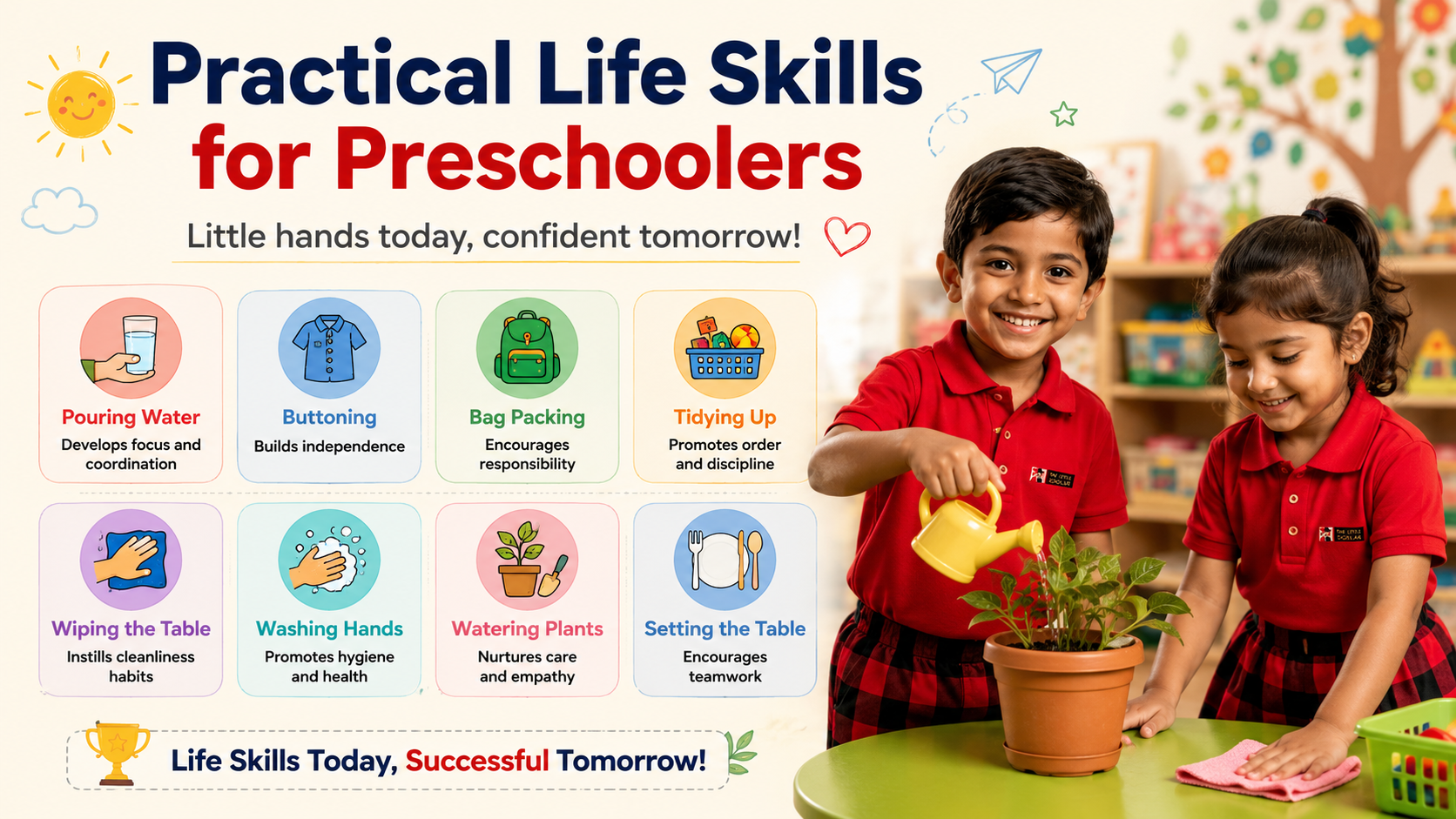
- Pouring water carefully
- Washing hands properly
- Brushing teeth and using tissues
- Dressing and undressing independently
Organisation
- Packing and unpacking school bags
- Putting toys back in place
- Folding and arranging clothes
- Caring for books and materials
- Following classroom routines
Social Skills
- Greeting people politely
- Saying please, thank you, and sorry
- Asking for help respectfully
- Sharing and taking turns
- Helping friends when needed
Emotional Skills
- Recognising and naming feelings
- Calming themselves when upset
- Solving simple disagreements
- Waiting patiently
- Making small choices independently
Responsibility
- Caring for classroom plants
- Conserving water and electricity
- Respecting nature and pets
- Cleaning up after activities
- Taking ownership of belongings
Safety Awareness
- Personal safety basics
- Good touch and bad touch
- Basic road safety rules
- Asking for help from trusted adults
- Age-appropriate digital habits
This may look like a lot, but children do not learn these skills through formal teaching. They pick them up through everyday opportunities and gentle expectations. A child who is asked to pack their snack box every morning learns organisation. A child who pours their own water learns coordination and control. A child who is greeted warmly every morning learns to greet warmly back. None of it requires a special programme. It requires an environment where these expectations are consistent and gentle, and where children are given the time to actually do things themselves.
How Independence Builds Real Confidence
Confidence in children is often misunderstood. It is not built by telling children they are wonderful. It is built by giving them genuine experiences of doing things and succeeding, sometimes failing, and trying again. A child who repeatedly experiences “I did that myself” develops a foundational belief that they are capable. That belief, once formed, opens the door to everything else they will try in their lives.
Practical life skills are particularly good at producing this kind of confidence because they are concrete. There is no ambiguity about whether you successfully poured a glass of water or whether you packed your bag. The result is visible to the child, and the satisfaction is immediate. Over weeks and months of small successes, something significant builds inside them.
This is also why excessive parental help can actually undermine confidence rather than build it. When an adult steps in to do something a child could have managed with a bit more time, the child loses the opportunity to feel capable. Over time, that loss adds up.
What to Expect at Each Age
Life skills do not appear all at once. They unfold across the preschool years, with each age bringing new capabilities. Knowing what is reasonable at each stage helps parents and teachers offer the right level of support, neither rushing children nor underestimating them.
The Beginning of Independence
Children this age can begin to feed themselves with a spoon, put toys away with reminders, take off shoes and socks, wash their own hands, and follow very simple instructions. They love to copy adults doing tasks. Encourage this even when it slows things down.
Building Routines
This is the age where children can take real ownership of routines. Dressing themselves with minimal help, packing their snack box, putting away their bag, helping to set the table, and managing simple personal hygiene. They are also ready to start using polite language naturally if they see it modelled consistently.
Genuine Capability
Children at this age can pack and organise their own school bag, fold simple clothes, water plants, pour drinks, share and take turns reliably, recognise their own emotions, and follow multi-step instructions. They begin to take pride in being helpful and seek out small responsibilities.
Ready for Real Responsibility
By this stage, children should comfortably manage their personal hygiene, organise their belongings, follow classroom and home routines independently, communicate their needs clearly, manage simple disagreements with peers, and take ownership of small daily tasks. This is the foundation that makes Class 1 and beyond run smoothly.
The Trap Parents Fall Into Without Realising
This is worth saying directly because it is so common and so well-intentioned. The single most frequent thing that undermines a child’s development of life skills is loving, well-meaning parents doing too much for them.
It is faster to feed a three-year-old than to wait for them to feed themselves. It is easier to pack the school bag than to coach them through doing it. It is more convenient to put away the toys than to insist they do it. Every one of these choices, taken individually, is reasonable. But repeated daily over years, they teach a child that things will be done for them. And that lesson is genuinely hard to undo.
The hardest part of building a capable child is not finding the right activities. It is having the patience to let things take longer than they need to, to watch a child struggle with a small task and not jump in, and to celebrate effort even when the outcome is imperfect. That patience is what builds the capable child you are hoping for.
Children rise to expectations. When parents and teachers communicate, in tone and through routine, that the child is capable of doing something themselves, the child usually responds. When the same adults consistently do things for the child, the child stops trying. Neither pattern is intentional. Both are powerful.
How to Build Life Skills at Home
The most effective life skill teaching happens not at preschool but at home, because home is where the most opportunities exist. Almost every household routine can be a learning moment if children are gently brought into it rather than worked around.
-
Making the bed together. Even a small child can pull a blanket up or straighten a pillow. It teaches sequencing and creates a sense of ownership of their space.
-
Sorting laundry. Putting dirty clothes in the laundry basket, separating socks by colour, helping to fold small towels. Excellent fine motor and matching practice.
-
Watering plants. A simple watering can and one plant assigned to the child creates real responsibility. They will check on it daily without being asked.
-
Setting the dining table. Even a three-year-old can place napkins or carry small unbreakable items. They will feel like a real contributor to the meal.
-
Matching lids to containers. While you cook, give them a basket of containers and lids. They will be focused for half an hour, and learning logic and patience the whole time.
-
Carrying their own things. Their backpack, a small bag of groceries, their water bottle. The principle is simple: if it is theirs, they carry it. This builds responsibility in a deeply concrete way.
-
Helping prepare a simple snack. Peeling a banana, spreading butter on bread, washing fruit. With supervision, children love being in the kitchen, and the learning is significant.
-
Returning books to the shelf. After a story, the child puts the book back themselves. Tiny moment, but the habit it builds carries across to homework, school books, and personal possessions later.
Most parents underestimate how many opportunities for life skill learning are already present in their daily routines. The shift required is not to add new activities, but to slow down enough to let children participate in the activities that are already happening.
How The Little Scholar Playschool Ghaziabad Builds Life Skills
At The Little Scholar Playschool in Kavi Nagar, Ghaziabad, life skills are not a programme that runs on Wednesday afternoons. They are part of how every single day is structured.
From the moment children walk in, they are unpacking and organising their own bags, placing their shoes neatly, and settling into their space. During the day, they serve themselves at snack time, pour their own water from child-sized jugs, clear their tables when they finish eating, and put away the materials they have used. Classroom plants are cared for by the children themselves. Helper roles rotate through the group so every child has the experience of being responsible for something that matters.
The classroom itself is designed to support all of this. Furniture is child-sized so children can manage it themselves. Shelves are labelled and accessible. Visual routines on the walls help children know what comes next without needing constant adult prompting. None of this is accidental. The environment is built to enable independence rather than work around children’s incapability.
Teachers at The Little Scholar follow a deliberate pattern: model first, demonstrate clearly, supervise while children try, and gradually step back as children become capable. The goal is never to do the task for the child. The goal is for the child to do the task themselves, with whatever level of support they currently need, and to need less support over time.
Life skills built into every classroom day
The result is visible over weeks. Children who arrived needing help with everything become children who pack their own bags, manage their own routines, and help their classmates without being asked. This transformation, more than any academic milestone, is what parents in Ghaziabad most consistently mention when they describe what The Little Scholar has done for their child.
Read what families across the city say about this on their Google Business profile.
The Long-Term Payoff
The benefits of strong life skill foundations show up across the rest of a child’s education and well beyond. The transition to Class 1 tends to be markedly smoother for children who already know how to manage their belongings, follow routines, and communicate their needs. Teachers can focus on teaching rather than constantly attending to logistical issues, and the child arrives ready to participate.
The same skills carry forward into adulthood, where they become things like organisation, responsibility, time management, and the ability to take initiative without being prompted. None of these qualities can be effectively taught at twenty-five. They have to have been growing since age three.
Children who become independent early also tend to develop a different relationship with effort. They have learned that doing something for themselves, even when it is hard, feels good. That experience, repeated thousands of times across the preschool years, builds a kind of resilience that no formal lesson can produce.
Looking for the Best Play School in Ghaziabad?
If you want a preschool where your child grows academically and as a person, where independence and life skills are taken as seriously as letters and numbers, the team at The Little Scholar Playschool Kavi Nagar is happy to help. The admission inquiry form takes just a couple of minutes.
Frequently Asked Questions
Why should life skills be taught in preschool?
Children between 2 and 6 are at the peak of their brain development, and habits formed in these years tend to last. Teaching practical life skills during preschool builds confidence, independence, school readiness, and responsibility in a way that is far harder to replicate later. Children who learn to take care of themselves and their belongings early grow into more capable, less anxious, and more resilient students.
What practical life skills should a four-year-old learn?
A four-year-old can reasonably be expected to feed themselves, wash their hands properly, dress with minimal help, pack their own school bag, organise their belongings, share with peers, say please and thank you naturally, identify and name their emotions, follow simple routines, and help with small household or classroom tasks. These are not unrealistic expectations. They are developmentally appropriate.
How does activity-based learning build life skills?
Activity-based learning gives children repeated opportunities to practice real-world tasks in meaningful contexts. Instead of being told how to do something, children actually do it. Over time, those small repeated experiences become natural habits. This is the most effective way to build life skills in young children, far more effective than verbal instruction alone.
Does The Little Scholar Playschool teach practical life skills every day?
Yes. Practical life skills are not a separate subject or weekly programme. They are built into every part of the day at The Little Scholar Playschool in Kavi Nagar, Ghaziabad. Children unpack their own bags, serve their own snacks, clear tables, water classroom plants, organise their materials, and take on small helper roles. Independence develops through ordinary routines rather than through lessons about independence.
Can life skills improve a child’s academic performance?
Yes, and the connection is direct. Children with better organisation, concentration, and self-regulation perform measurably better in academic tasks. A child who can sit through a structured activity, follow instructions, manage their own materials, and ask for help when needed is set up to learn far more effectively than one who cannot. Life skills and academic readiness are deeply connected.
What makes The Little Scholar the best play school in Kavi Nagar Ghaziabad?
The Little Scholar Playschool focuses equally on academics, creativity, values, emotional intelligence, and practical life skills. With decades of experience and a team of warm and experienced teachers, the school is widely regarded as one of the best play schools in Ghaziabad for holistic early childhood education. You can read parent reviews on their Google Business profile.
Small Tasks, Big Children
The image that often comes to mind when people imagine a “good education” is a child sitting quietly with a book, learning their letters. That picture is not wrong, but it is incomplete. The fuller picture also includes a child who can dress themselves, pack their own bag, clear their own plate, and look out for the friend next to them who needs help.
That child is being prepared not just for school, but for life. For the kind of life where being capable is itself a source of confidence, where independence feels good rather than burdensome, and where responsibility is something they pick up naturally rather than something they have to be lectured into.
The years between 2 and 6 are when this kind of person gets built. Quietly, without drama, through the small ordinary moments of every day. The schools and homes that take those moments seriously are the ones producing children who, years later, walk into the world with a quiet sense that they can handle what comes next. For families in Ghaziabad looking for that kind of preschool, the conversation is worth having.