
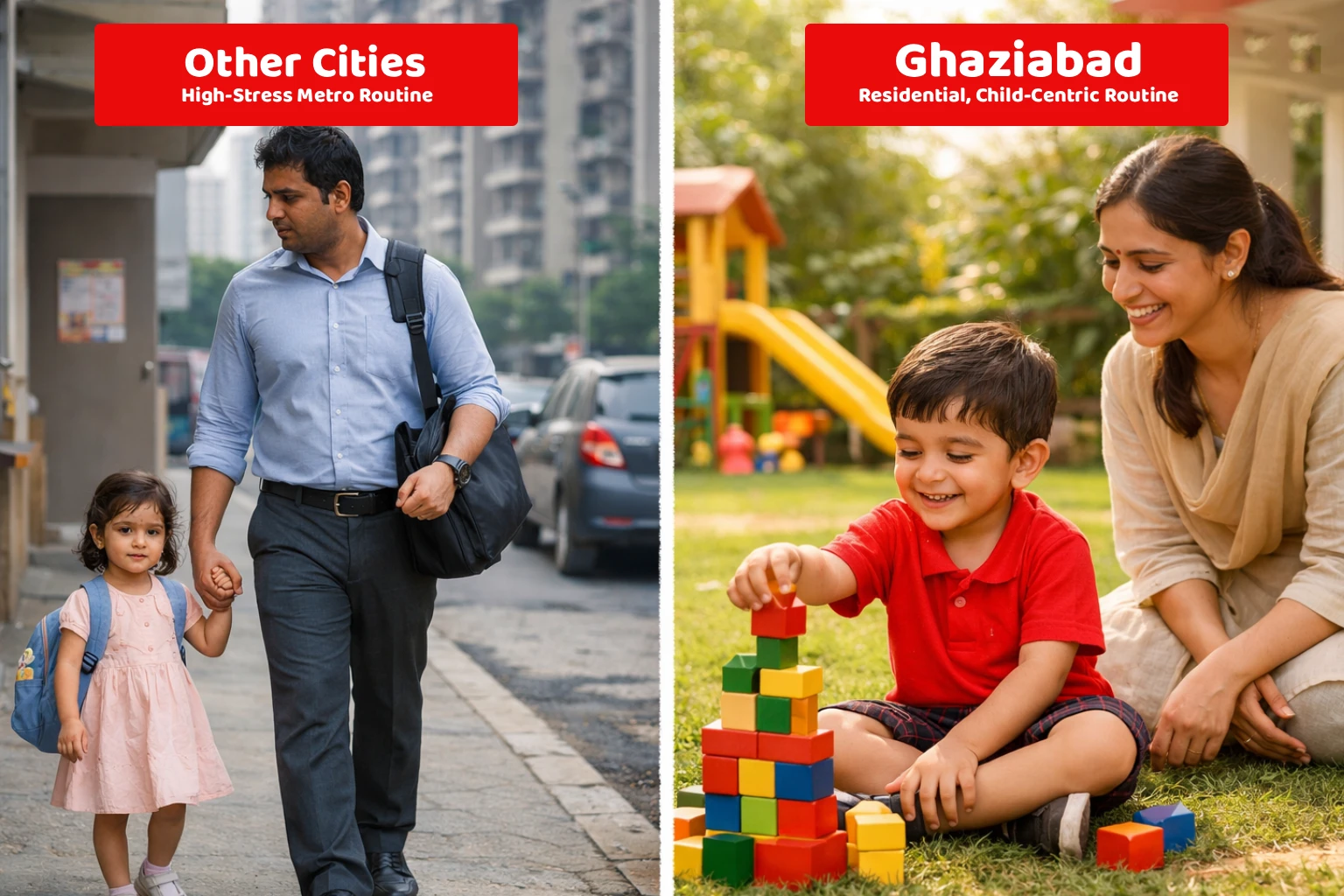
For working parents across Delhi–NCR, mornings rarely begin calmly. Between getting ready for office, preparing children for the day, and navigating traffic-heavy routes, the first few hours often feel like a race against time. Add unpredictable work schedules and long commutes, and it becomes clear why Parents Prefer a Playschool in Ghaziabad—early education decisions are increasingly shaped by practicality rather than prestige.
With dual-income households now forming a significant portion of urban India, parents are reassessing what truly matters during their child’s early years. Increasingly, the choice of where a child spends their formative hours is influenced by daily routines, commute stress, and lifestyle balance rather than just brand names or city reputation.
According to recent urban household studies, nearly 33% of Indian families now rely on dual incomes, and in metro-adjacent regions like Delhi–NCR, this number rises even higher. Early education choices are increasingly influenced by daily logistics rather than traditional perceptions of city hierarchy. (source: economic.indiatimes.com)
This shift explains why many working families are now exploring options beyond Delhi or Noida. The decision isn’t about one city being better than another—it’s about finding an early education environment that fits modern working lif
The Reality of Working Parenthood in Metro Cities
Time, Traffic, and the Daily Balancing Act
Urban working parents today juggle more roles than ever. Hybrid work models blur boundaries, office hours stretch unpredictably, and household responsibilities don’t pause for deadlines. Studies show that a majority of NCR parents list commute-related stress as their biggest quality-of-life concern.
A regional NCR survey found that over 68% of working parents rank commute stress as their top lifestyle concern, even above housing or schooling costs. This explains why proximity-based schooling has become a deciding factor rather than an afterthought.
Playschools, in this context, are no longer just places for learning alphabets or social play. They function as structured support systems that help parents manage time, maintain consistency, and ensure emotional security for their children.
For families where both parents work—or where one parent manages extended hours—early education becomes an essential part of daily stability. This reality is driving growth in the preschool sector, especially in cities where accessibility and routine matter more than high-profile addresses.
Commute Matters More Than Parents Realize
Why Distance and Daily Travel Shape Playschool Decisions
It’s easy to underestimate how travel time impacts a child’s day. In Delhi, parents lose close to 187 extra hours annually due to traffic congestion. While Noida offers more planned routes, peak-hour congestion still creates long, stressful journeys.
Ghaziabad presents a different rhythm. Many residential sectors are designed around daily living—schools, parks, healthcare, and markets located close to home. For working parents, this means fewer transitions, shorter travel windows, and calmer mornings.
Choosing a playschool in Ghaziabad often reduces daily travel by 1.5 to 3 hours. For toddlers, that saved time translates into better sleep, fewer mood swings, and smoother transitions between home and school. For parents, it means evenings that feel less rushed and more present.
Cost vs Convenience: A Practical Perspective
Balancing Quality Education with Financial Sustainability
Rising preschool fees across metro cities have forced parents to reconsider what they are paying for. In Delhi, premium early education can cost as much as a monthly household expense. Noida, while slightly more balanced, still commands higher annual fees.
Ghaziabad offers a different equation. Average preschool fees here remain noticeably lower while maintaining comparable learning standards. Many parents find they can access play-based learning, trained educators, and safe infrastructure at nearly 20% lower costs.
This affordability allows families to invest in consistency rather than compromise—choosing stability over luxury and long-term sustainability over short-term branding. It’s one of the reasons why working parents often shortlist a playschool in Ghaziabad early in their decision-making process.
Why Neighborhood-Based Playschools Work Better for Working Parents
The Advantage of Residential Proximity
One of Ghaziabad’s strongest advantages lies in its neighborhood planning. Areas like Rajendra Nagar, Kavi Nagar, and Ghanta Ghar host a high concentration of residentially embedded playschools. These setups allow parents to manage drop-offs within 10–15 minutes, even during peak hours.
Neighborhood-based playschools also foster stronger community connections. Parents see familiar faces, teachers understand local family dynamics, and children grow up alongside peers from their immediate surroundings.
A well-located playschool in Ghaziabad integrates seamlessly into a family’s daily routine, unlike distant hubs that require planning entire schedules around traffic and timing. For working parents, this ease often becomes the deciding factor.
Playschool + Daycare: A Key Decision Factor
How Integrated Care Supports Dual-Income Families
Modern working families look beyond half-day programs. With standard work hours extending from 9 to 6—and often beyond—full-day playschool and daycare combinations are increasingly preferred.
Integrated care reduces emotional transitions for young children. Staying in one familiar environment throughout the day builds trust, emotional security, and predictability. Parents, too, benefit from not having to coordinate multiple caregivers.
India’s preschool sector has responded by expanding hybrid models that combine early learning with extended care. Many families find that a playschool in Ghaziabad offering such integration fits better into their professional lives without compromising their child’s well-being.
Emotional and Social Benefits for Children
Stability, Familiarity, and Better Early Development
Children thrive on routine. Shorter commutes, consistent schedules, and familiar surroundings significantly reduce anxiety in toddlers and preschoolers. When children attend playschools close to home, they arrive calmer and more receptive to learning.
Neighborhood familiarity also strengthens social bonding. Children form deeper connections when they see classmates outside school—in parks, community events, or local gatherings. This continuity supports emotional development during critical early years.
For working parents dealing with long office hours, these emotional benefits make choosing a nearby playschool in NCR especially in Ghaziabad feel less like a compromise and more like a thoughtful parenting decision.
What Working Parents Actually Look for Today
A Realistic Checklist for Choosing the Right Playschool
Rather than focusing solely on city reputation, parents now prioritize practical factors that affect daily life:
- Safe infrastructure and hygiene: Clean classrooms, CCTV, and child-safe design
- Teacher availability: Balanced ratios (around 1:10) and trained staff
- Parent communication: Daily updates, transparent feedback, and open access
- Flexible timings: Early drop-offs and late pick-ups for working schedules
- Proximity: Residential locations over distant commercial hubs
- Learning approach: Holistic, play-based learning over flashy branding
Search trends show parents increasingly evaluating these criteria when researching a playschool in NCR especially Ghaziabad, reflecting a shift toward thoughtful, lifestyle-aligned choices.
Ghaziabad as a Case of Evolving Metro Parenting
A City Reflecting New-Age Family Priorities
Ghaziabad represents a broader urban trend. As metro-adjacent cities evolve, they offer families the balance that large metropolitan cores often struggle to maintain—career access without daily chaos.
Affordable housing, expanding infrastructure, and a growing number of early education institutions have made Ghaziabad an attractive choice for professionals working across Delhi–NCR. Parents here are not settling; they are intentionally designing routines that support both ambition and family life.
This evolution mirrors global urban parenting patterns, where convenience and emotional well-being now outweigh location prestige.
Conclusion
For working parents, choosing a playschool is no longer about city labels. It’s about how well a school fits into everyday life. Shorter commutes, reasonable costs, integrated care, and emotional stability for children are shaping early education decisions across NCR.
Ghaziabad’s residential structure and practical advantages make it a compelling choice for families seeking balance. In the end, it’s not about choosing between Delhi, Noida, or Ghaziabad—it’s about choosing what works best for your child and your daily reality.
A Gentle Next Step for Parents
If you’re exploring early education options closer to home, you may want to look into neighbourhood-based playschools in areas like Kavi Nagar that align with working-family routines.
👉 Click here to contact The Little Scholar – a playschool in Ghaziabad